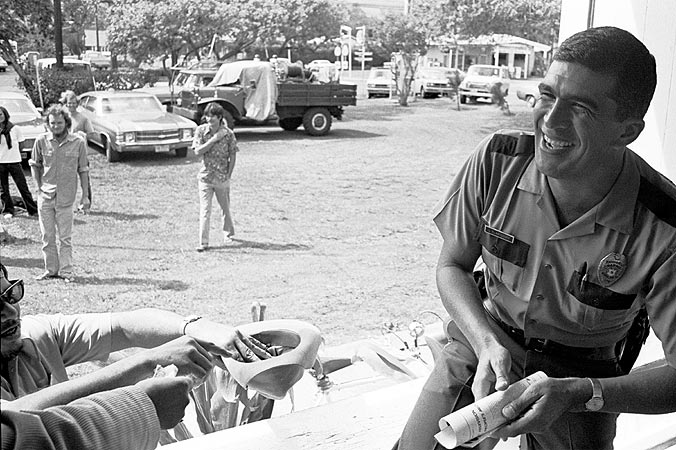
There’s a column in Wednesday’s edition of West Hawaii Today by Leningrad Elarionoff, who was the arresting officer at the May 1974 protest by Sonny Kaniho and his supporters, who symbolically occupied a Waimea pasture leased to Parker Ranch by the Department of Hawaiian Home Lands (“My Turn: Kapu aloha in 1974 practiced the real meaning“).
Elarionoff, who was later elected to the Hawaii County Council, describes the differences he sees between the aloha displayed by Kaniho in 1974, and the “Kapu Aloha” of those blocking access to Mauna Kea, from the perspective of being an officer on the scene. In his case, the only officer on the scene in 1974, as I recall.
The day arrived and Kaniho, with numerous friends and supporters, gathered at the gate of the property on the Kohala Mountain Road. At the planned hour, they lifted the gate off the hinges and entered the property. The Parker Ranch security called the police and I proceeded to the scene. On my arrival, a group of protesters had already gone beyond the gate. I parked my patrol unit on the roadside among those observers who, not wishing to be arrested, remained on public land. The security personnel gave me a ride to the protest group gathered a ways up on the property in question.
At my arrival, the group surrounded me and we talked respectfully among ourselves. Now the fun part. I took down their names and informed them all that they were under arrest for trespassing. I then informed them to meet me at the police station for booking.
As we left the scene, they worked with the security guard to reinstall the gate. Kapu aloha was demonstrated by the protesters. They showed respect and drove their own vehicles to the police station for processing. Their beef was with the Hawaiian Home Commission, not the arresting officer.
In the Maunakea protest, the arrested kupuna refused to move and had to be carried away for processing. Their idea of kapu aloha was to make it inconvenient for everyone not actively supporting their cause. Had the Kaniho demonstration practiced the same kapu aloha as the Maunakea group, one cop carrying all 18 of them would have been an impossible task. Again, their beef was with the Hawaiian Homes Commission, not with me, the arresting officer.
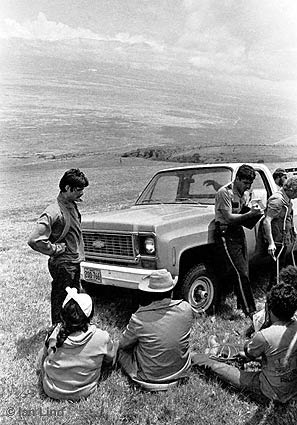 I was among the group arrested that day. To me, a Honolulu kid, it was amazing to be in that pasture looking down to the ocean beyond. It seemed like we were sitting at the top of the world. And when the Hawaii County police officer arrived on the scene, it was Sonny’s cousin, Leningrad.
I later wrote: “You couldn’t make this up–being arrested at the top of the world by a Hawaiian cop named Leningrad.”
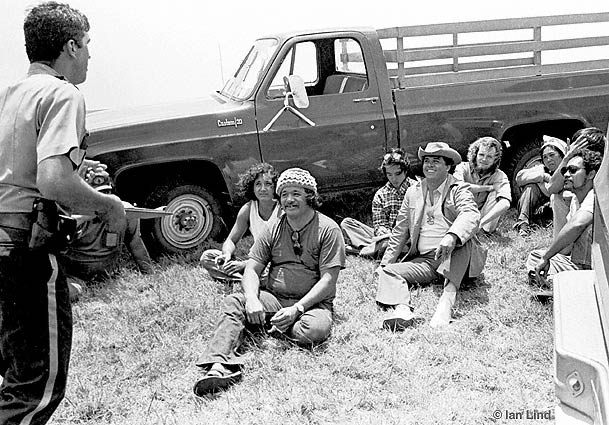
Leningrad then writes that we were all asked to meet him at the Waimea police station for processing.
To tell you the truth, I don’t recall this part of the tale. And the photos that I’ve posted in the past of the protest don’t include a stop at the station. While on the mountain, Leningrad did ask to see identification from each of us, which was then used to issue everyone a penal summons.
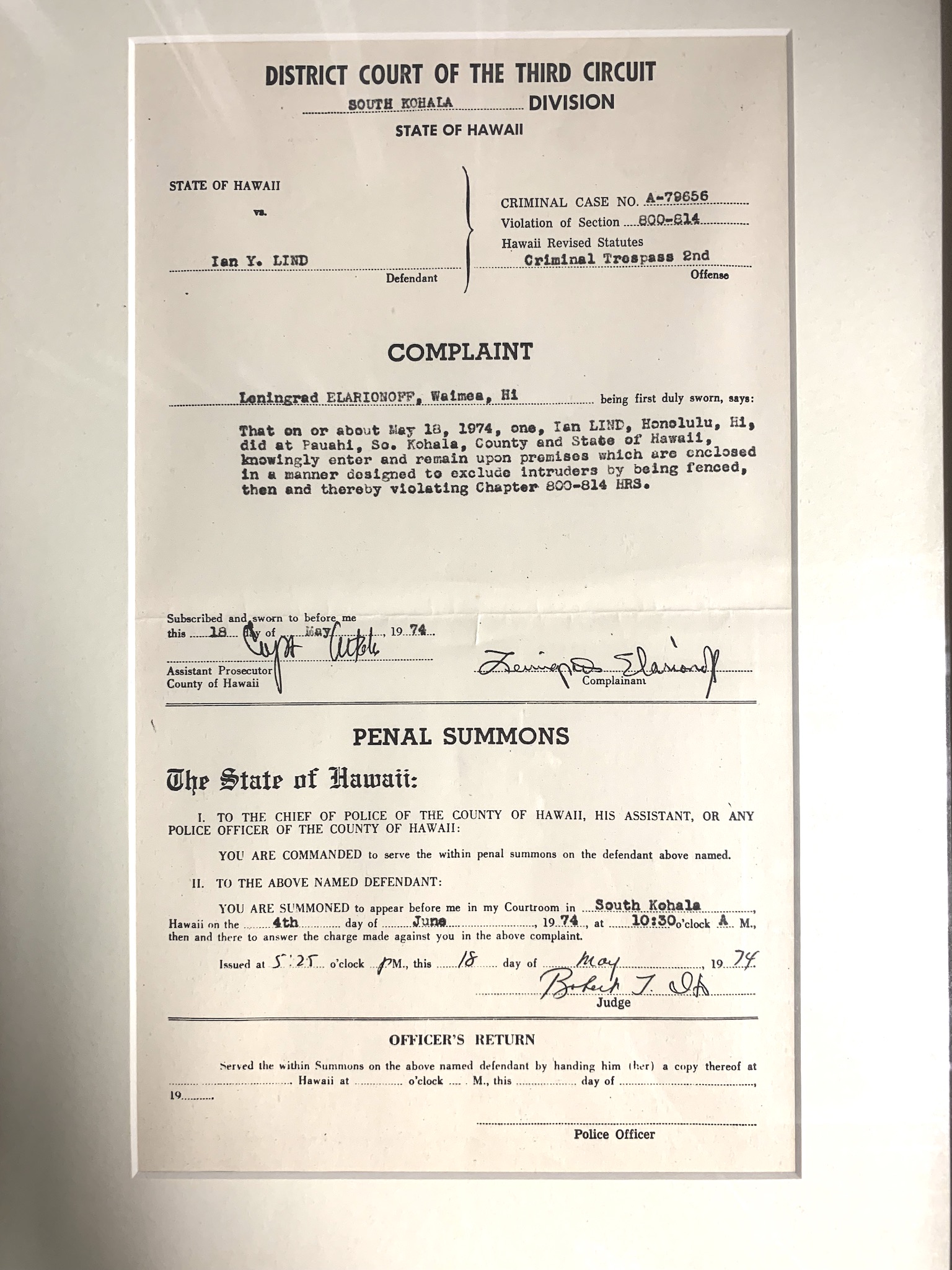
My recollection is that those of us from off-island were free leave, with the understanding that we would receive a summons to appear in court. Perhaps the Big Island residents were processed at the station. I’ll have to tap into someone else’s memory to resolve that discrepency.
But Elarionoff’s description of good feelings between himself and the Kaniho protesters on the day of our trial was certainly accurate. Several of my photos show him in friendly interactions after our trial ended in acquittal. In the photo below, a hat was being passed around to collect money for refreshments, and it was waved in front of Elarionoff in a good-natured way, and he seems to have had good laugh about it.