Category Archives: Hawaiian issues

A nice performance worth sharing

I recorded this on Friday afternoon, August 23, 2019.

This performance was part of “A Musical Journey Through Oahu Cemetery,” a program marking the 175th Anniversary of Oahu Cemetery. Four stations were set up in different parts of the 18-acre cemetery, each presenting a short musical tribute to a group of Hawaii musicians and composers who are buried in the cemetery.

In this short segment, Doug Tolentino and Beau Bassett sing Kaulana Na Pua, written in 1893 by Eleanore Prendergast. It was hot, humid, and by this time, raining. It didn’t seem to dampen their performance.

The first part of Tolentino’s introduction, which wasn’t captured on the video, explained that following the overthrow of the Hawaiian Kingdom, government workers were told they would have to sign an oath pledging loyalty to the new provisional government. The bandmaster of the Royal Hawaiian Band went to Mrs. Prendergast for help with music that could be a form of protest.

If you are unfamiliar with the words and their message, check the Wikipedia entry.

Hawaii Supreme Court issues important ruling on Hawaiian language education

Among the social media comments made regarding the controversy over the Thirty Meter Telescope on Mauna Kea, many chastise the state government and courts for doing nothing to protect Hawaii from rampant overdevelopment or to protect Hawaiian rights.

In my view, though, Hawaii’s courts have stood up to tremendous political pressure and insisted that the Legislature and the Executive branches uphold provisions of the State Constitution written explicitly to protect important native rights.

For several years, judges and justices were threatened with loss of retirement benefits, or politicization of the appointment process, in apparent retaliation for a high court decision that the legislature had for years breached its constitutional responsibilities to provide sufficient funds to the Department of Hawaiian Homes.

And the Hawaii Supreme Court added to its line of cases on Hawaiian rights in a decision issued on August 13. The decision came in a lawsuit filed on behalf of a mother and her two childeren on Lanai. They wanted to enroll the children in a Hawaiian immersion program. When no such program proved to be available on Lanai, the family filed suit, claiming a constitutional right to enter an immersion program.

The court was called on the interpret Article X, Section 4 of the State Constituion.

The State shall promote the study of Hawaiian culture, history and language.

The State shall provide for a Hawaiian education program consisting of language, culture and history in the public schools. The use of community expertise shall be encouraged as a suitable and essential means in furtherance of the Hawaiian education program.

The court had to decide whether the Department of Education was fulfilling its constitutional responsibilities.

The Supreme Court, in a split ruling, held that the Department of Education must make “all reasonable efforts” to provide students access to a Hawaiian language emersion program. It sent the case back to the Circuit Court for a review of whether the DOE had in fact made “all reasonable efforts” to provide such learning Lanai.

But while the court’s opinion is important for future educational decisions, its decision is also useful for its concise statement of the history of government suppression of the Hawaiian language, and the changes that the restoration and reinvigoration of the language can be expected to have.

This is clearly important background for understanding what is happening on Mauna Kea.

First, here is the court’s summary opinion. For the full reasoning of the court, you will have to read the full opinion.

There were three opinions filed in the case. A majority of three justices, Sabrina McKenna, Richard Pollack, and Michael Wilson signed the opinion written by Justice Pollack. Chief Justice Mark Recktenwald had a separate, concurring opinion, while Justice Paula Nakayama also filed a separate opinion, concurring in part and dissenting in part. [An earlier version of this post incorrectly said that the Chief Justice had dissented from the majority opinion.]

OPINION OF THE COURT BY POLLACK, J.

“The language of a people is an inextricable part of the identity of that people. Therefore, a revitalization of a suppressed language goes hand in hand with a revitalization of a suppressed cultural and political identity.” Shari Nakata, Language Suppression, Revitalization, and Native Hawaiian Identity, 2 Chap. Diversity & Soc. Just. F. 14, 15 (2017).

Historically, the Hawaiian language played a fundamental role in all aspects of Native Hawaiian society. It was utilized not only for practical communication in daily life, but also to express and preserve creation and genealogical chants, prayers, histories, narratives, proverbs, n? mele, and other knowledge that connected Native Hawaiians with each other and their ancestors through a shared cultural identity. This common link was nearly severed as a result of Western colonialism, which sought to impose English as the exclusive medium of communication as part of a larger effort to forcefully assimilate the Hawaiian people. Central to this process was the banning of the use of the Hawaiian language in schools—an extremely effective tactic that had driven the language to the brink of extinction by the latter half of the twentieth century.

It was at this critical time that a series of amendments aimed at revitalizing the Hawaiian language was made to the Hawai`i Constitution, including a provision obligating the State to provide for a Hawaiian education program in public schools consisting of language, culture, and history. Thereafter, a grassroots effort led the State to establish a number of Hawaiian immersion public schools in which Hawaiian is the standard language of instruction. The children who attend these schools become fluent in the Hawaiian language, and the program has resulted in great progress toward reversing the decline in the number of Hawaiian language speakers.

Today, there are Hawaiian immersion schools on five of the major Hawaiian Islands, but no such program exists on the island of L?na`i. This case arises from a suit by a mother living on L?na`i on behalf of herself and her two school-age daughters. The mother argues that the provision of the Hawai`i Constitution obligating the State to provide for a Hawaiian education program in public schools requires the State to provide her daughters with access to a public Hawaiian immersion education.

On review, we hold that the Hawaiian education provision was intended to require the State to institute a program that is reasonably calculated to revive the Hawaiian language. Because the uncontroverted evidence in the record demonstrates that providing reasonable access to Hawaiian immersion education is currently essential to reviving the Hawaiian language, it is a necessary component of any program that is reasonably calculated to achieve that goal. The State is therefore constitutionally required to make all reasonable efforts to provide access to Hawaiian immersion education. We remand for a determination of whether it has done so.

The court also included a section describing official policies that tried to enforce a prohibition on teaching or speaking Hawaiian. Again, an important and useful summary.

2. Post-Overthrow Suppression

Three years after the overthrow, the newly formed Republic of Hawai`i enacted legislation officially declaring that “[t]he English language shall be the medium and basis of instruction in all public and private schools . . . . Any schools that shall not conform to the provisions of this section shall not be recognized by the Department.” Contemporary sources suggest that the law was specifically intended to eradicate knowledge of `olelo Hawai`i in future generations. The number of Hawaiian-medium schools dropped precipitously as a result of the legislation; 150 such institutions existed in 1880, and none remained by 1902. Simultaneously, Hawaiian children and teachers were disciplined for speaking `olelo Hawai`i in public school, with teachers in some instances even being dispatched to Hawaiian-speaking homes to reprimand parents for employing the language to speak to their children.

The law was largely successful at achieving its apparently intended effect. Although the government instituted by the overthrow was replaced when Hawai`i was annexed by the United States and again when the islands achieved statehood, `olelo Hawai`i newspapers, church services, and other cultural touchstones all but disappeared as native-speaking communities continued to dwindle. Minor efforts to reintroduce `olelo Hawai`i into the public school curriculum as a supplemental foreign language course did little to arrest its decline. At its lowest point, there were as few as fifty native speakers of the language under the age of 18. `olelo Hawai`i was thus in danger of becoming a dead language when, in the 1970s, civil and indigenous rights movements across the nation coincided with a period of renewed interest in Native Hawaiian culture that became known as the Hawaiian Renaissance. During this period, a traditional Hawaiian proverb became popularized among advocates for the revitalization of `olelo Hawai`i: “E ola mau ka `olelo Hawai`i,” which has been translated as “the Hawaiian language must live on.” [Footnotes and references removed for easier reading]

In the end, the court did not recognize an absolute right for any child to be offered access to an immersion program. However, it offered suggestions of the kinds of accommodations the DOE should be considering.

The State should thus act with the goal of reviving and preserving `olelo Hawai`i and the shared culture to which it is inextricably linked when determining whether it is reasonable to take additional steps to provide access to a Hawaiian immersion program. These steps might include providing greater financial or other incentives to attract immersion teachers to Lana`i, furnishing transportation for a teacher to commute to Lana`i, using multiple instructors to share teaching duties, partnering with community members knowledgeable in `olelo Hawai`i, modifying school days or hours of instruction to accommodate the availability of a teacher, or adopting any other alternative method of providing access to a Hawaiian immersion program. Ultimately, all reasonable alternatives are to be considered to determine whether access to a Hawaiian immersion program is feasible, and the State is constitutionally obliged to take a reasonable course of action that would afford access to Clarabal’s daughters if any exists.

This, and other court decisions on Hawaii rights, including those on the TMT itself, do not reflect a judicial system insensitive to or unsupportive of native rights. That’s something TMT protectors and supporters need to keep in mind.

Hawaii Supreme Court to hear case involving state’s breach of Hawaiian Homes trust

On Wednesday, August 21, the Hawaii Supreme Court will hear oral arguments in the case of Kalima v State of Hawaii.

This is another case involving rights of beneficiaries of the Hawaiian Homes Commission Act was originally filed in 1999. No, that’s not a typo. We’re talking 20 years. And these Hawaiians, who have been adjudged to have suffered damages caused by the state’s breach of trust to Native Hawaiian benficiaries, are still waiting. Some plaintiffs died waiting.

The court issued an earlier opinion in this case on June 30, 2006, which summarized the background of the layers of problems with the Hawaiian Homes program over the years.

A.The Hawaiian Home Lands Trust

During the early 1900s, concern about the plight of the Hawaiian people who had been displaced from rural to urban areas began to emerge as a result of the serious disruption in their traditional way of life. Out of concern for the declining numbers of full-blooded Hawaiians and the recognition that all previous systems of land distribution were ineffective, Congress entertained various homesteading proposals designed to rehabilitate the native Hawaiian people. Eventually, Congress enacted the HHCA, creating a land trust from ceded crown and public lands that was intended to rehabilitate the native Hawaiian people by, inter alia, making them eligible to receive the benefits of homesteading through leased land and related programs from the trust.6 The HHCA designated certain public lands on the five major Hawaiian islands as “available lands.” HHCA §203 (1993). However, notwithstanding the efforts of various individuals, including Senator John Wise and Prince Jonah Kuhio Kalaniana‘ole, the available-land designation excluded some of the best agricultural lands of the territory, leaving the trust lands under the HHCA poorly suited to achieving the act’s intended purposes. Title to the Hawaiian home lands vested in the United States until the Territory of Hawai‘i became a state on August 1, 1959, at which time the newly formed State of Hawai‘i entered into a compact with the United States to assume the management and disposition of the Hawaiian home lands. Hawai‘i Admission Act of March 18, 1959, Pub.L. 86-3, §§ 4 & 5, 73 Stat. 4 (1959) (Hawai‘i Admission Act or Admission Act). The HHCA, together with the Hawai‘i Admission Act, impose upon the State the duties and obligations of trustee to oversee the operations carried out under the authority of the HHCA.

Despite the HHCA’s admirable goals, controversy plagued the trust from its inception in 1921 and continued after its transfer to the State in 1959. The problems were of such magnitude that, in 1983, a Federal-State Task Force on the HHCA was convened. The Task Force submitted a report to the State that identified several areas of concern and made recommendations for improvement. The areas included, inter alia: (1) problems with the HHCA program itself that affected the trust as a whole, involving (a) the lack of an inventory of the Hawaiian home lands, (b) the lack of useable lands, (c) the lack of proper funding sources, and (d) the improper use/sale/exchange of Hawaiian home lands by state and federal governments; and (2) administrative problems affecting individual beneficiaries, such as (a) delays related to the application and eligibility determination processes and (b) delays resulting from mismanagement of the long waiting lists.

With that background, here’s the summary of the case to be heard on Wednesday as it appears on the court’s website:

No. SCAP-18-0000068 Wednesday, August 21, 2019, 8:45 a.m.

LEONA KALIMA; DIANE BONER; RAYNETTE NALANI AH CHONG, special administrator of the estate of JOSEPH CHING, deceased; CAROLINE BRIGHT; DONNA KUEHU; IRENE CORDEIRO-VIERRA; and JAMES AKIONA, on behalf of themselves and all others similarly situated, Plaintiffs-Appellees/Cross-Appellants, vs. STATE OF HAWAII; STATE OF HAWAII DEPARTMENT OF HAWAIIAN HOME LANDS; STATE OF HAWAII HAWAIIAN HOME LANDS TRUST INDIVIDUAL CLAIMS REVIEW PANEL; DAVID Y. IGE, in his official capacity as Governor of the State of Hawaii, Defendants-Appellants/Cross-Appellees.

The above-captioned case has been set for argument on the merits at:

Supreme Court Courtroom
Aliiolani Hale, 2nd Floor
417 South King Street
Honolulu, HI 96813

Attorneys for plaintiffs-appellees/cross-appellants Leona Kalima, et al.:

Carl M. Varady of Law Office of Carl M. Varady and Thomas R. Grande of Grande Law Offices

Attorneys for defendants-appellants/cross-appellees State of Hawaii, et al.

Clyde J. Wadsworth, Solicitor General; Kimberly T. Guidry, Robert T. Nakatsuji, and Kalikoonalani D. Fernandes, Deputy Solicitors General

NOTE: Certificate of Recusal, by Associate Justice Sabrina S. McKenna, filed 01/25/19.

NOTE: Order assigning Circuit Court Judge Matthew J. Viola, in place of McKenna, J., recused, filed 01/29/19.

NOTE: Order granting Application for Transfer, filed 02/05/19.

COURT: Recktenwald, C.J., Nakayama, Pollack, and Wilson, JJ., and Circuit Court Judge Viola, in place of McKenna, J., recused.

Brief Description:

This transfer case concerns the calculation of damage awards to beneficiaries of the Hawaiian Home Lands Trust (“the trust”) who were injured as a result of the State of Hawaii’s (“the State”) breaches of the trust. Petitioners are beneficiaries of the trust whose time on the waiting list to receive homestead land was prolonged due to the State’s breaches of the trust.

In Kalima v. State (Kalima I), 111 Hawaii 84, 137 P.3d 990 (2006), this court held that Petitioners were permitted to file a complaint seeking individual damages under Hawaii Revised Statutes Chapter 674. On remand, the Circuit Court of the First Circuit (“the circuit court”) first found the State liable for various breaches of the trust. It later adopted a fair market value based damages model to calculate the damages to be awarded to each waiting list beneficiary. Another trial was held to resolve methodological issues regarding the circuit court’s fair market value model. In 2018, the circuit court entered a final judgment.

On appeal, the State contends that the circuit court erred in (1) establishing an overbroad subclass list; (2) finding that the State breached its trust duties by not recovering lands that were “withdrawn from the Trust prior to Statehood[;]” (3) adopting a damages model that is not connected to the breaches of trust that were found by the circuit court; (4) adopting a damages model that fails to limit recovery to “actual damages” as required by statute; (5) applying the Oahu fair market rental value model for residential leases to the entire State; (6) incorrectly determining that subclass members had no duty to mitigate damages until 1995; (7) incorrectly providing for temporary suspension of damages when claimants “deferred” from participation in a homestead offering; and (8) shifting the burden of proof to the State on essential elements of Petitioners’ case.

On cross-appeal, Petitioners argue that the circuit court erred in (1) ruling that beneficiaries must prove out-of-pocket expenditures to recover individual damages; (2) ruling that a waiting list subclass member’s “deferred” status suspends their individual damages; (3) imposing a six-year delay before individual damages accrue; (4) not bringing damages to present value; and (5) adopting the “best fit” curve and reducing individual subclass damages.
Another link between TMT and 1974 protest by Sonny Kaniho

A state Senate committee hearing this past week raised questions about legal ownership of parts of the Mauna Kea access road where the current protests are taking place, potentially weakening the state’s ability to take more aggressive actions to clear TMT opponents from the access road.

According to the Honolulu Star-Advertiser report on the information meeting:

About 50 years ago, the Department of Transportation built Mauna Kea Access Road over Department of Hawaiian Home Lands property without permission. That road and others throughout the state that were built on DHHL land became part of a much bigger $600 million settlement that the state entered into in 1995 to compensate DHHL for the misuse of Hawaiian home lands. As part of that agreement, known as Act 14, the state was required to compensate DHHL for Mauna Kea Access Road via a land swap.

However, the state never executed a land transfer, DHHL Director William Aila told lawmakers during a legislative briefing called by the Senate Hawaiian Affairs Committee.

It called to mind a 1974 protest by a Hawaii Island rancher, Sonny Kaniho, who had been on the Hawaiian Homes waiting list for a number of years. Kaniho was seeking a lease of pasture land, and became increasingly distressed by the granting of pasture leases to commercial interests, including Parker Ranch, while qualified Hawaiian lessees remained in waiting list limbo.

Finally, in May 1974, Kaniho took direct action, backed up by a small group of supporters. Together they removed a gate in to a 375-acre pasture leased to Parker Ranch, and symbolically “occupied” the pasture.

Hawaii County police issued trespass citations, and those cited were ordered to face trial on the charges in the district court in Waimea.

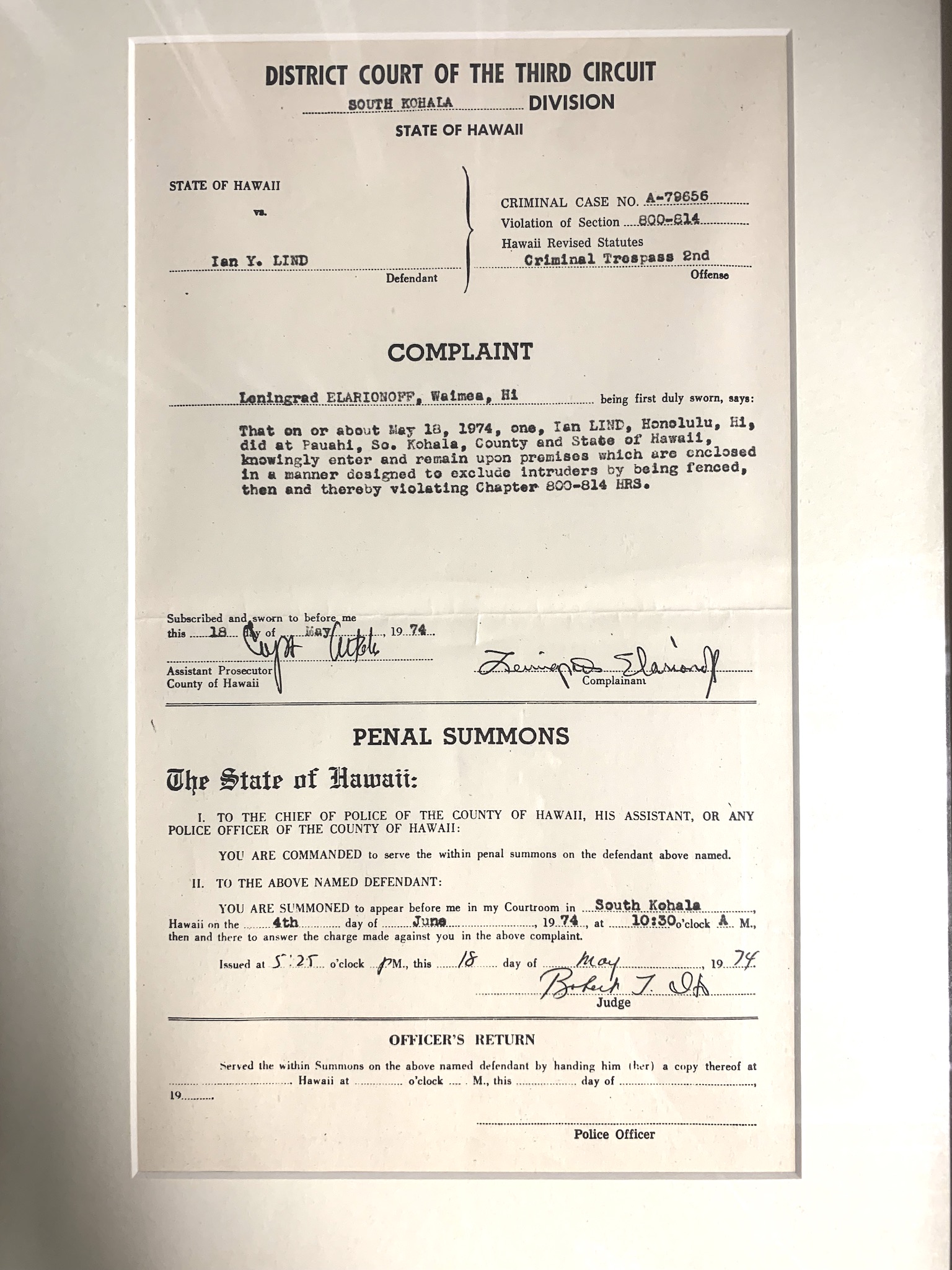
I’m familiar with the case because I was one of those charged with trespass and facing trial. The official complaint served on me appears below. Just click on the photo to read the document.

Kaniho and 17 supporters went to trial in August 1974. During the trial, attorney Robert “Gil” Johnston elicited testimony showing that the Parker Ranch lease had expired at the end of 1973. This prompted Judge Norman Olds ruled the land had reverted to state ownership at the expiration of the lease, and that as a result the defendants had not trespassed on Parker Ranch property. Trespass charges dismissed!

The Parker Ranch leases had been extended beyond their expirations under a provision allowing short-term permits of up to a year after lease expiration, presumably so that the lease terms could be renegotiated. In this case, however, that had not happened, and Judge Olds ruled that it made all the difference in this case.

The lease to Parker Ranch, and similar leases to other commercial interests, were made because chronic underfunding of Hawaiian Homes programs necessitated commercial use to generate income that could in turn fund the department’s administrative and development budgets.

So there were series of what could reasonably be seen as breaches of duties to Native Hawaiian beneficiaries, to the benefit of other segments of the public.

Chronic underfunding was the result of legislative decisions that prioritized other interest groups ahead of qualified Hawaiians waiting for homestead leases.

The decision to rely on commercial leases for income, while understandable as a reaction to chronic underfunding, could again be reasonably seen as putting private commercial interests ahead of those of DHHL beneficiaries.

Then add the broader context provided by the 1983 report of a joint federal-state task force, which determined that thousands of acres of Hawaiian Homes Commission land was illegally taken from the homestead program by executive orders between 1923 and 1969, including land under the Hilo Airport.

In 1985, Gov. George Ariyoshi approved approved returning to the Department of Hawaiian Home Lands 27,836 acres that had been illegally transferred over the years.

And a decade later, the state agreed to pay $600 million, and to take other steps (including the land swap for the Mauna Kea access road) as compensation for past illegal use by the state. But when the agreed upon land swap didn’t happen, it was again Hawaiian interests suffered.

Whether or not the failure to make the land swap back in the 1990s leaves the State Department of Transportation in the same position as Parker Ranch in 1974 is an open question.

However, it does add to the series of transactions in which Hawaiians were promised, but did not receive, their due.

And there are many more examples, including the Hawaii Supreme Court’s finding several years ago that the legislature breached its constitutional duties by failing to provide sufficient funds for the DHHL administrative budget.

In the broad sweep of things, it’s no wonder to me that Hawaiians are angry and resentful, feelings are are now on public display in the TMT controversy.