Category Archives: Hawaiian issues

Guest Post: “Absolutely never,” says OHA’s Maui Trustee Hulu Lindsey on TMT

Maui reporter Susan Halas interviewed OHA Trustee Carmen Hulu Lindsey on August 11, 2019, in Kahului, Maui. Halas is a longtime reporter who covered the protests against the bombing of Kahoolawe back in 1976-77 for the Maui News, and was the only neighbor island reporter who covered the 1978 Constitutional Convention, where Hawaiian issues were at the forefront.

My position on building the TMT telescope on Maunakea is “absolutely never,” said Carmen Hulu Lindsey. Lindsey, 75, is an elected board member to the Office of Hawaiian Affairs (OHA) representing Maui. Asked if there was any wiggle room in that stance she was emphatic, “it’s non-negotiable.” She termed the mountain the ‘piko’ (navel) of the entire Hawaiian culture, adding, “that to most Hawaiians it is very sacred. On this there is no room for compromise. Even if it is not built on the island of Hawaii there are many problems with the 13 existing prior telescopes on Maunakea that have not been addressed. I think it’s time for TMT to move to another location and I expect to hold firm on that.”

Lindsey was one of many Hawaiian elders (kupuna) who visited the mountain recently and she was also one of the more than thirty who were arrested for their participation in efforts to protect the site from what they perceived as “desecration.” She said that the views she expressed, “my own opinion as an individual” and do not represent the position of OHA.

She went to the mountain on her own initiative. Once there she found herself very moved “sitting on mauna and talking to Aunty Pua Kanahele. I was overwhelmed by the unification I saw and felt. This is definitely not business as usual. The spiritual and the intangibles are important enough that they have to come first. An awakening is happening, a positive awakening, where we will go from here I don’t know, but I do know we have to take care of this issue first. ‘E’o’ – stand up for what you believe in.”

Lindsey also disagrees that the TMT went through the permitting process in a lawful manner: she stated that, “important facts put by Brian Kawika Cruz in the 2017 Cultural Impact Assessment (CIA) were left out, if they were included we would not be facing this subject today.”

She was also critical of Hawaii Governor David Ige. Referring to the other 13 existing telescopes on the summit, she noted that, “Ige has had plenty of notice to start decommissioning at least five of them, and has yet to start work on any.”

“Nothing!” she said, “Nothing at all.” If he really wanted TMT built, why didn’t he start on the decommissioning?”

Lindsey made it clear that she does not feel the governor’s sympathies lie with the Hawaiian people. “He’s already showed where he stands,” she said, noting in her opinion both the “money and the management come up short.” She reiterated what many before her have said that the $1 a year in lease rent from the DLNR to UH is far from a fair or equitable payment for use of the ceded lands which are supposed to be held in trust for the benefit of native Hawaiians.

“Our people will stand strong,” she said, indicating she sees little possibility of either a negotiated settlement or a change of heart.

Referring to the Unity Rally on Maui on August 10 which drew an estimated 5,000 to 7,000 participants, the largest political crowd seen on Maui in this century, she said: “Our people came out with one thing in mind, unifying and perpetuating our beliefs, and it’s not just our people. There are a lot of other people who feel the same way, who have the same values as we have. I don’t want to make a separation: they love like we love. It’s not just us. We embrace their support.”

“Maui is in the forefront,” she said referring to the TMT opposition. She attributed the solidarity, at least in part, to the resurgence in interest in things Hawaiian “from preschool through college. Teaching of the Hawaiian language has a perpetuating and multiplying effect.”

As to whether the political power that is implicit with the huge Maui turn out for the TMT issue can be transferred to other areas of Hawaiian concern, she thought “that discussion is premature. I’m not sure it transfers but we’ll have to see. This issue is ‘political’,” she acknowledged, “but it’s not ‘political’ in the traditional sense. Let’s take this one first.”

Though many have been critical of OHA as a body, saying it has not done enough to further the interests of the Hawaiian people it was set up to serve, Lindsey responded, “I was warned it was a tough position. Each member has their own ideas on how to serve our people, I respect my fellow board members, even if I don’t agree.”

OHA is a nine member board, each member is elected to a four year term. The job has no term limits. Lindsey was originally appointed to the seat by former Gov. Abercrombie and has subsequently been re-elected, “I’m going on my 8th year,” she said. A Pukalani resident, she travels to Oahu on a weekly basis to attend OHA meetings. The annual compensation for the position is $55,000 per year.

She said the official OHA mission is to improve the living conditions of Hawaiian people, and observed that substantial funds flow through the office. “My first priority is to be able to provide affordable homes for all our families.” She also mentioned a $150,000 grant targeted to improving the health of Hawaiians in the Hana district of East Maui.

Lindsey was not the only member of the OHA board to visit the mountain in the past month. Others who made the journey were Chair Colette Machado of Molokai and Dan Ahuna of Kauai, both of whom made personal visits the encampment.

The other members of the nine member board are Brendon Lee (At Large), Leina‘ala Ahu Isa (At Large), Robert K. Lindsey Jr. (Hawaii Island), John D. Waihee IV (At Large), Kalei Akaka (Ohau), Keli’i Akina (At Large).

“I went to the mountain knowingly,” she said, “I wanted to support the protectors.” She indicated that the huge turn-out for the recent Maui rally confirmed that there are thousands here who share this view.

[Photo of Carmen Hulu Lindsey by Susan Halas]
On disobedience and escalating demands

I was listening to an episode of The Takeaway on NPR yesterday, and one brief segment caught my attention because it seems to echo concerns about the current civil disobedience taking place on Mauna Kea.

The Takeaway was examining the protests in Hong Kong that had shifted to the airport.

Commenting was Orville Schell, who had witnessed the Tiananmen Square protests in 1989. This is from his Wikipedia entry:

Orville Hickock Schell III (Chinese: ??; pinyin: Xià W?i; born May 20, 1940) is an American writer, academic, and activist. He is known for his works on China, and is the Arthur Ross Director of the Center on U.S.-China Relations at the Asia Society in New York. He previously served as Dean of the University of California, Berkeley Graduate School of Journalism.

In any case, here’s an excerpt from Schell’s comments.

What’s hauntingly familiar is sort of the arc of the demonstrations, the way they gather momentum, and keep reinventing themselves in order to keep people engaged.

I think your report from the Hong Kong airport reminds me very much of what happened in May in Beijing in 1989. The students decided to do a hunger strike as a tactic to kind of reinvigorate the protest. I think it was a very clever tactical move that the students moved to the airport, a highly symbolic place where people come and go, a nerve center of Hong Kong, and also a public space, a big lobby of a big airport.

There are lots of ways that you see similar kinds of escalations, and I think the very worrisome part is that each time there is an escalation, and each time they sort of gather a new group, a new grievance, a new demand, of course it becomes more impossible to imagine a resolution short of confrontation.

Of course, in Hong Kong they’re talking about a potential violent confrontation with a Chinese military force as the ultimate threat.

In Hawaii, a military response of that kind isn’t in the cards. But there could be a law enforcement response that could lead to violence.

When one side says it isn’t going to negotiate, how do we imagine “a resolution short of confrontation” in Hong Kong or on the mountain?

A bit of fake news from the protectors

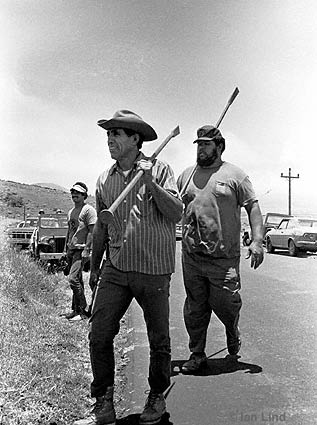
Perhaps that headline is a bit too strong. Perhaps not meant as fake news, but clearly this photo is an example of a very creative, fictional recreation of a past event. The photo is real. The story is not.

This photo surfaced on Facebook yesterday in a post apparently aimed at “protectors” of Mauna Kea.

The caption tells a tale.

PROTECTORS FROM 1974 NEAR MAUNA KEA ROAD GOING UP WAIKI’I ROAD – one of the first stand off’s regarding the telescopes.
Uncle Sonny Kaniho, Uncle Andrew Akau along with almost all the Parker Ranch workers & there families, this is one of my first memories of my daddy standing to stop the trucks from bringing up the stuff for build the telescopes.

It does seem to have struck a chord. By early this morning, it had drawn 100 comments and had been shared over 1,000 times.

It is indeed a photo of Sonny Kaniho and Andrew Akau in 1974. No offense meant, but the caption is fiction. The photo has absolutely nothing to do with any telescopes, or stopping trucks from going up the road. That’s definitely a false narrative.

How do I know that it’s a fake story? It’s my photo. It contains my digital watermark. I took the photo back in 1974, during a protest high up on the Big Island’s Parker Ranch.

Kaniho was protesting policies of the Hawaiian Homes Commission and Department of Hawaiian Home Lands that resulted in land being leased to private interests while thousands of Hawaiians sat on waiting lists for years, even decades, for homestead leases on some of the same lands.

Kaniho’s protest involved removing a gate to a Parker Ranch pasture which was held under a lease from DHHL, entering the area, and symbolically claiming it for himself and other Hawaiians who were waiting endlessly for land.

I was among a group of supporters who accompanied Kaniho and were cited for trespassing.

The case was heard later in 1974 at the courthouse in Waimea. During the trial, it was disclosed that the lease on that parcel had expired and that it technically was now public land, not Parker Ranch land. Trespass charges were dismissed.

A small but important event in the history of Hawaiian activism. But it had nothing at all to do with telescopes or protecting Mauna Kea. That story was a work of creative fiction, or perhaps just memory being recreated for modern times.

Several ideas worth repeating

I’ve been looking back at prior things I’ve written that deal with issues raise by the current Hawaiian uprising on Mauna Kea.

On the top of my list: “Ian Lind: Dangerous Intersection of Social Policy and ‘Sacred’“, Civil Beat, April 29, 2015.

To the extent that opposition to the construction of the TMT is grounded in ideas of what is considered “sacred” according to particular current beliefs about Native Hawaiian religious traditions, we’re in that dangerous territory where public policy and religious beliefs collide. Working through such differences in a diverse society such as ours is necessarily difficult.

Luckily, we’ve evolved a legal approach to religious rights that, with time and a bit of luck, allows different religions and religious communities to co-exist within our society.

With this in mind, it’s instructive to look at how the issues of the sacredness of Mauna Kea, along with the protection of traditional Hawaiian religious and cultural practices, were dealt with during the prolonged contested case hearing conducted under the auspices of the Board of Land and Natural Resources.

“Ian Lind: The ‘Kingdom Defense’ Is a Dead End for Mauna Kea Protesters,” Civil Beat, July 22, 2015.

I can understand and sympathize with those who rely on the Kingdom defense in order to make a very public political statement that they oppose the state’s policy for development of Mauna Kea. That’s well and good. But they shouldn’t have any expectation that this particular defense has any chance of prevailing in court or shielding them from the legal consequences of civil disobedience.

Asserting the jurisdiction of the Kingdom may make for lively political theater, but as a legal argument, it’s clearly a loser. And holding the approach out as a realistic legal strategy does a disservice to these and other potential defendants.

“Hawaii Monitor: Is Part of the Sovereignty Debate Just a Matter of Faith?”, Civil Beat, March 5, 2014.

Here’s the problem that I see. Hawaiians have experienced a prolonged period of downward relative social mobility. They might be better off than before, but have lost ground relative to other ethnic groups. In my view, this decline doesn’t date back to 1893, or 1898, but to the post-WWII period.

After all, in the first decades of the 20th Century, following annexation, Hawaiians made up the largest segment of the islands’ electorate. Many Hawaiians, probably a majority, followed leaders like Prince Kuhio and John C. Lane, into the Republican Party, even during those decades when the Big Five and the Caucasian elite dominated the islands’ politics and economy through the GOP.

During the decades that followed, up through World War II, Hawaiians benefited greatly from political patronage, and dominated the ranks of police officers, firefighters, teachers, and other government employees.

That changed in the post-war years, as the Democratic Party gained power by building a political coalition around the Japanese-American voting block. Although many Hawaiians also worked hard for Democratic victories, the ethnic makeup of the government workforce clearly changed, to the detriment of the Hawaiian community.

Somehow, while other, more recently arrived ethnic groups have climbed up the social ladder, Hawaiians still have more than their share of poverty, ill health, poor housing, imprisonment, unemployment, and other social problems. Progress, economic development, and the passage of time have brought fewer benefits to Hawaiians than to other segments of the community, or so it seems.

Anyway, the links will take you to the full columns. Food for thought.