Category Archives: Hawaiian issues

Scammer convicted in federal tax refund fraud was part of earlier Hawaiian sovereignty scam

The U.S. Attorney’s Office for the District of Hawaii announced Friday that four defendants were convicted for their parts in a complex tax refund fraud scheme that falsely obtained over $1 million in fraudulent federal tax refunds.

From a news release:

HONOLULU – A federal jury convicted four individuals from Hawaii this week for their roles in a tax refund fraud scheme.

The following is according to court documents and evidence presented at trial: from at least January 2015 through September 2018, Rosemarie Lastimado-Dradi, Marciaminajuanequita Dumlao, Elvah Miranda, and Daniel Miranda conspired to defraud the United States. As part of their scheme, the conspirators filed fraudulent individual tax returns and other tax documents that reported false withholdings from mortgage lenders and then claimed substantial refunds from the IRS. After processing the false returns, the IRS issued refunds totaling over $1 million.

To prevent the IRS from recovering the fraudulently obtained refunds, the conspirators created trusts, opened new bank accounts in the names of business entities and the trusts, and transferred the proceeds between the accounts to conceal them from the government. In addition, Lastimado-Dradi, Dumlao, and Elvah Miranda laundered the fraudulently obtained refunds through a series of bank transactions. Dumlao and Daniel Miranda also each filed for bankruptcy and made false statements under oath in relation to their respective bankruptcy proceedings.

All the defendants were found guilty of conspiracy to defraud the United States. In addition, the jury found Lastimado-Dradi, Dumlao, and Elvah Miranda guilty of money laundering. Daniel Miranda and Dumlao were found guilty of making false statements under oath in a bankruptcy proceeding. Finally, Elvah Miranda was also found guilty of filing a false tax return, and Lastimado-Dradi was found guilty of aiding and assisting in the preparation of false tax returns. Dumlao was acquitted of filing a false tax return and four money laundering counts. Daniel Miranda was acquitted on one count of filing a false return.

I flagged the original indictment because one of the defendants, Rose Dradi, was also part of a fraudulent foreclosure relief scheme involving David Keanu Sai, a prominent proponent of the idea that the Hawaii Kingdom was never extinguished and now exists as an occupied territory, and Dexter Kaiama, a former Hawaiian attorney who tried to use Sai’s argument as a defense in court cases.

“Sai, who claims to be an expert on sovereignty issues, maintains that the continued existence of the Kingdom of Hawaii means that the State of Hawaii does not exist,” attorneys for the state’s Office of Consumer Protection argued in a 2018 lawsuit. “According to Sai, there are no state laws, and there are no state courts. Sai claims to know all of this first-hand because Sai claims to be an acting minister/diplomat for the Kingdom, and Kaiama is supposedly the Kingdom’s acting attorney general.”

I wrote about the scam in a 2019 post after OCP challenged a foreclosure case in which the homeowners used documents prepared by Sai and Kaiama in an attempt to defeat the lender’s foreclosure. According to OCP, Dradi identified and solicited potential “clients,” and then managed their communication with Sai and Kaiama.

Sai, the agency alleges, has a standard written contract that clients are asked to sign which requires them to pay a fee before services can be provided. Dradi often serves as Sai’s assistant, soliciting clients, obtaining payment, and coordinating with them in advance of court appearances, the agency says. She has often been the “primary point of contact between consumers and Sai.”

Once fees are collected, Sai then allegedly provides a written answer to the foreclosure lawsuit or a “motion to dismiss” that contests the court’s jurisdiction based on his theory that all U.S. or Hawaii law is unenforceable here because Hawaii remains an independent state. The motion is provided in a standard format which the property owners are advised to sign and file in court “pro se,” without the benefit of an attorney.

The agency alleges this scheme “in which Sai’s supposed expertise on Hawaiian sovereignty issues is packaged as part of a motion to dismiss, has been shown to be of no benefit….No judge presiding over a foreclosure case has yet to be convinced that the case must be dismissed for lack of subject matter jurisdiction based upon the continued existence of the Kingdom of Hawaii, and yet Sai keeps offering his services and illegally collecting his fees in advance.”

And when the sovereignty argument fails in court, as it consistently has, the agency says the home owners have incurred additional costs and delays, and as a result “have essentially squandered any meaningful chance they had to save their property….”

The Office of Consumer Protection referred the case for possible criminal prosecution in 2019. Hawaii News Now reported at the time that Sai had taken nearly $8,000 in fees from homeowners facing foreclosure who believed Sai’s assistance would save their homes.

“Sai’s conduct constitutes a felony and Sai’s criminal wrongdoing has been referred to the proper criminal authorities for investigation,” OCP attorney James Evers said in a court filing.

No criminal charges were filed in response to the referral, and neither Sai nor Kaiama was tied to Dradi’s larger tax refund scam.

In June 2020, attorney Kaiama settled a civil lawsuit brought by the Consumer Protector by agreeing to be permanently barred from providing “legal services or any other assistance” to any homeowner whose property is facing actual or threatened foreclosure.

Two years later, in December 2022, Kaiama abruptly surrendered his law license after refusing to cooperate with an investigation by the Office of Disciplinary Counsel, and refused to respond to an order of the Hawaii Supreme Court to show cause why he should not be immediately suspended. Several weeks later, the court made the suspension official, precluding Kaiama from reactivating his law license absent approval from the disciplinary counsel.

A small contribution to a book about Kahoolawe for young readers

In early 2022, I received an email from a woman I didn’t know who had questions about my participation in the first protest landing on the island of Kahoolawe in January 1976.

“I’m working on a middle-grade nonfiction book project on Kaho?olawe, including a chapter on the January 1976 first landing,” longtime Leeward Community College writing prof Kamalani Hurley wrote. “I’m looking for the details and cool/nerdy facts that will make that time — especially before the authorities showed up — more real and relatable for middle grade readers. How cool it must’ve been to be the photographer at this history-making event!”

As often happens, it was lost in my email and over four months passed before I noticed it. I replied, apologizing profusely, wondering whether I had missed the boat. Luckily, that wasn’t the case.

More than a year later, I was contacted by artist and teacher Harinani Orme, who was working on the illustrations for Hurley’s book, and had run into my photos of that 1976 landing and its aftermath posted online.

“I would like to ask your permission to be inspired by your photographs as I draw for the book (vague figures, gear on the beach, planted niu on the beach, boat, beach landscape, etc),” she said.

Long story short. Their book was released this year. It’s a gem, and is now available at Da Shop in Kaimuki and local bookstores, as well as via Amazon, Powell’s Books and, perhaps, other online booksellers.

Honolulu Magazine published an interview with Hurley about the Kahoolawe book, which has garnered glowing reviews, several of which are quoted on the author’s website.

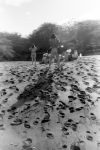
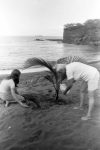
The finished book includes a two-page spread describing the 1976 landing. Orme’s illustration is a stylized representation incorporating elements from several of my photos, which I’ve included below.

Oh, for the record. Here’s a photo of me, along with Gail Kawapuna Prejean and Steve Morse, as we are being escorted off of Kahoolawe to a Coast Guard ship waiting offshore. Before long, each of us received a letter from the 14th Naval District barring us from returning to Kahoolawe. My framed letter may be the only original in existence after 49 years.

Yikes. Next January will be the 50th anniversary of that first landing.

Peeking down a rabbit hole

You may wonder how Alicia Napua Hueu got the title “Governor of Maui” that she used in the “cease and desist” letter decribed in Monday’s post concerning the January 2020 takeover of a property in Kipahulu.

I puzzled over that, wondering how one comes to believe they are an island governor in the Kingdom of the Hawaiian Islands.

Then I recalled something I had found online a couple of years ago while reporting on the takeover of several acres of agricultural land in Kunia, above Waipahu. Hueu was a cheerleader and advisor to the group involved in that incident which involved several other members of Occupied Forces Hawaii Army. Hueu claimed the rank of Captain in OFHA as well as “Judge Advocate General.” She took her role seriously enough that she appeared in court and attempted to represent OFHA, but of course was not allowed to do so because she is not an attorney.

A little backtracking and I found this item in my files. Welcome to the fantasy lineup of one of the competing sovereignty groups out there in the wild, this one associated with the musician, Leon Siu.

Screenshot

False theory about Kingdom land patents leads to first felony convictions

A Maui woman who sparked several takeovers of private land based on a mistaken understanding of Native Hawaiian rights has pleaded “no contest” to criminal charges for her admitted role in the illegal occupation of the home and property of a retired state judge.

Alicia Napuaonalani Hueu entered a “no contest” plea in a Maui courtroom earlier this year to 1st degree theft, a Class B felony, as well as two misdemeanor charges, obstructing a government function and criminal property damage. Two of her co-defendants also pleaded guilty to felony charges, one to 1st degree theft and another to 1st degree burglary. Charges against two others were dropped by prosecutors as part of their plea deal with Hueu.

All three defendants were granted a deferred acceptance of their pleas, and released on 4-years probation. If they stay out of trouble and comply with the terms of their probation, the convictions will be removed from their records.

This is believed to be the first time felony charges have been successfully brought against Hawaiians wrongly asserting native land rights under the false theory of “heirdom” promoted by Hueu, which asserts a “lineal descendant” of the original recipient of a Hawaiian Kingdom-era royal land grant retains an ownership interest “in perpetuity” that is superior to modern land titles and gives the right to control the property. In this view, neither time nor valid prior property sales or transfers can extinguish the ownership rights of descendants.

Whether its proponents are able to suspend their sense of reality enough to accept this theory as true, or have cynically weaponized it as a narrative to generate support for native Hawaiian land rights and sovereignty, isn’t clear from the record.

Other similar property takeovers based on claimed family ties to specific properties have generally been treated as civil disputes over land title, no matter how flimsy the claims put forward under the guise of native rights. This has left the legal owners to fend for themselves, and bear the substantial cost, in time and money, of defending their title and regaining access to their own property through protracted civil court proceedings.

Although courts have upheld some challenges to past takings of land from Hawaiian families, those victories required evidence showing title had never been validly sold or otherwise legally transferred over the intervening century and a half since the original royal patents were issued.

The theory of “heirdom,” in contrast, eschews analysis of title claims and instead relies entirely on genealogical ties to the original land grant recipient.

“Cease and Desist”

Hueu was arrested on January 4, 2020 after she and others took over 3.3 acres of land and 2-bedroom small two-bedroom home located along Hana Highway in Kipahulu, Maui. The property was owned by retired District Court Judge Douglas McNish and his wife, who had purchased it in 2006 for $1.55 million, and had listed it for sale in 2019, real estate records show.

McNish served as a family court judge on Maui from 1984 until his retirement at the end of 1999. News clippings show he was well regarded, and is credited with launching a program in 1988 requiring couples who have filed for divorce to attend a workshop concerning the impact of divorce on children. The program was later expanded into courts statewide and is now known as “Kids First.”

On November 29, 2019, five weeks before the confrontation that led to Hueu’s arrest, she sent a “cease and desist” letter by certified mail to McNish and his wife alleging they were trespassing,”illegally” occupying an “unpermitted” home on the property, and conducting an “unauthorized” land sale.

The site was identified as part of 273-acres conveyed by royal land patent No. 1902 to Kaumaia and nine others in December 1855.

The letter itself identifies Hueu as “Governor of Maui” in the “Kingdom of the Hawaiian Islands.” After her arrest, Hueu also described herself as “representative and caretaker for descendants of Kaumaia.”

Elsewhere, she described herself as “a Hawaiian National and Prisoner of War residing on the Island of Maui within the Kingdom of the Hawaiian Islands / Sandwich Islands.” She also claimed the titles of “Captain” and “Judge Advocate General” in Occupied Forces Hawaiian Army, a Hawaiian nationalist group that purports to be the military of the Hawaiian Kingdom, now engaged in “civil affairs” while under occupation.

Later, in a federal court proceeding, Hueu said she is a “foreign national, subject and or citizen not belonging to the United States[.]”

The “cease and desist” letter includes a replica of the Hawaiian Kingdom royal crest, and uses a return address, “Kingdom of the Hawaiian Islands” at a post office box in Haiku used by Hueu.

The letter meanders from citations to Hawaiian Kingdom laws of 1859 to references to 20th century international laws of war, The Hague and Geneva Convention, and boldly claims authority to order McNish to vacate.

The Kingdom of the Hawaiian Islands hereby gives you notice that the descendants of Kaumaia are the sole kuleana holders of the properties described above. As the kuleana holder, the descendants of Kaumaia hold exclusive rights to exercise its authority over the subject properties as governed under Kamehameha III 1850 self-executing Ratified Treaty with the United States of America.”

Under said authority, the Kingdom of the Hawaiian Islands has NOT granted permission for use of the subject properties, in whole or in part, to you or any organization you are affiliated with. You and any other parties or groups you represent or are otherwise affiliated with are therefore trespassing on Kaumaia kuleana land; LCA helu 1902….

…The Kingdom of the Hawaiian Islands demand that you immediately remove all structures and personal property from the subject properties. Access for removal of structures and personal property can be requested from the Kingdom of the Hawaiian Islands Governor of Maui office and removals must be completed by 12/13/19. Be advised that any existing or new structure(s), and equipment remaining on the property after 12/13/19 is subject to disposal pursuant to Kamehameha III Treaties, 1852 Constitution, Civil and Penal Codes of the Hawaiian Islands.

Sometime in the latter part of December, following the letter’s deadline, an associate chained and locked the gate into the McNish, according to Hueu’s later testimony before the Maui Police Commission. McNish apparently removed them, prompting Hueu’s associate call Maui police and file a complaint of criminal property damage, valuing the missing broken chain and locks at $95.

It was an audacious scheme, breaking into and taking over someone’s land and house, changing the locks, then accusing the legal owner of tresspassing when they try to reenter their own property, and asking the police to enforce your fictitious title.

It didn’t work for long. Two days later, on January 3, a police report said Hueu was trespassing on the property.

The following day, police returned, cut a new set of chains and locks that had been placed on the entry gate, and entered the property. Hueu was taken from the scene in handcuffs and later charged with extortion, theft, and burglary, all felonies, along with a long list of related misdemeanors. After languishing in court for over three years, the case was concluded when Hueu accepted a plea bargain.

It remains to be seen whether prosecutors will be inclined to consider felony charges when the victim of this kind of calculated land theft is a regular citizen without the resources and connections of a retired judge.