Category Archives: Mike Miske

Judge dismisses two additional charges against Mike Miske, 16 other charges stand

Two charges against former Honolulu business owner Michael J. Miske Jr. have been dismissed by federal Judge Derrick Watson in a 9-page order filed at 2:33 p.m. Monday afternoon.

Counts 8 and 9 of the third superseding indictment charged Miske with attemped murder in aid of racketeering, and corrying and using a firearm in a crime of violence, both stemming from the ambush of Lindsey Kinney at Kualoa Ranch in 2017.

Watson said the government had failed to establish Miske’s intent to murder Kinney, and that evidence presented was not sufficient to establish intent.

“There is simply no way a rational trier of fact could construe this testimony, along with the other evidence in the record, as shedding any light on the intent necessary for a conviction under Count 8,” Watson’s order says. “Therefore, the Court finds that Miske is entitled to judgment of acquittal on that count.”

Similarly, since the associated count of carrying a firearm requires conviction on the crime of violence, in this case the murder of Kinney, the firearm charge is also without sufficent evidence.

Prosecutors had previously dismissed Count 16 of the indictment, which charged Miske with being part of a general drug trafficking conspiracy with other associates. However, a similar drug trafficking conspiracy charge stemming from a failed 2014 cocaine buy in California remains.

Watson denied challenges to three counts relating to the use of the chemical chloropicrin in attacks on two nightclubs that competed with a nearby club that Miske owned and operated, as were Miske’s challenge to two bank fraud charges stemming from the alleged submission of falsified documents in support of vehicle loans from the Bank of Hawaii.

Watson’s order, which appears below, means the remaining 16 charges Miske faces remain. [An earlier version of this post incorrectly reported there are 17 remaining charges.]

Miske’s attorneys will begin presenting the defense case on Wednesday morning, June 12.

ORDER GRANTING IN PART AND DENYING IN PART MICHAEL J. MISKE JR.'S MOTION FOR JUDGMENT OF ACQUITTAL by Ian Lind on Scribd

The government has rested its “case in chief” against accused racketeering boss Mike Miske

The government rested its case today after five months of trial. The court will “go dark” for a week, and the trial will resume on Wednesday, June 12, when the defense will begin presenting its case.

The government has presented hundreds of witnesses, and concluded with days of somewhat mind-numbing testimony about corporate and individual tax liabilities.

Several apparently key witnesses were, surprisingly, not called to testify.

These include Lance Bermudez, whose reputation as a “shooter” brought him into the Miske organization, and who was described as being involved in several murder-for-hire plots backed by Miske; Jason Yokoyama, who was an employee and figurehead who publicly claimed ownership of the M Nightclub and other businesses Miske has been shown to shown to have owned and controlled; and Delia Fabro Miske, who had been married to Miske’s late son, Caleb, and who was intimately involved in his businesses.

Other testimony tied Yokoyama and Bermudez to parts of the plot to kidnap and murder Jonathan Fraser, which was allegedly carried out at Miske’s command. The government’s failure to call them as witnesses would appear to weaken the chance of convicting Miske for Fraser’s murder.

Two things happened after the jury was dismissed for the day.

First, Miske’s attorneys filed an oral motion for a judgment of acquittal on all counts, and arguments were presented by both sides. Judge Derrick Watson did not rule immediately, and said he would issue a written order on the motion.

Second, the government dismissed Count 16 of the Third Superseding Indictment. The government had originally charged Miske with conspiring with ten co-defendants to
sell methamphetamine, cocaine, and oxycodone, between about 2016 and 2018. Although Miske wasn’t shown to be directly involved, the government had alleged that the network of drug dealers was protected from attack or retaliation by their association with Miske’s organization. All of those co-defendants–John Stancil, Kaulana “Shorty” Freitas, Lance “Hammah” Bermudez, Dae Han Moon, Preston Kimoto, Harry “Harry Boy” Kauhi, Norman Akau III, Hunter Wilson, and Jarrin Young–have all previously pleaded guilty.

Although Count 16 was dropped, Miske continues to face charges stemming from an attempted deal to purchase more than 10 pounds of cocaine from a group in Los Angeles. Miske allegedly put up the money to finance the deal, which was broken up when drug agents stopped a three-car caravan escorting the two men sent from Honolulu to make the buy.

Prosecutors hit some rough going this week

Federal Judge Derrick Watson, the trial judge in the case against former Honolulu business owner Mike Miske, publicly expressed his frustration several times this week with the Assistant U.S. Attorneys handling of the case.

On Monday afternoon, Watson criticized prosecutors for failing to provide supplemental exhibit lists on a timely basis, giving defense attorneys inadequate time to review and prepare. As a result, Watson ruled that the latest round of proposed exhibits could not be used when questioning any upcoming witnesses.

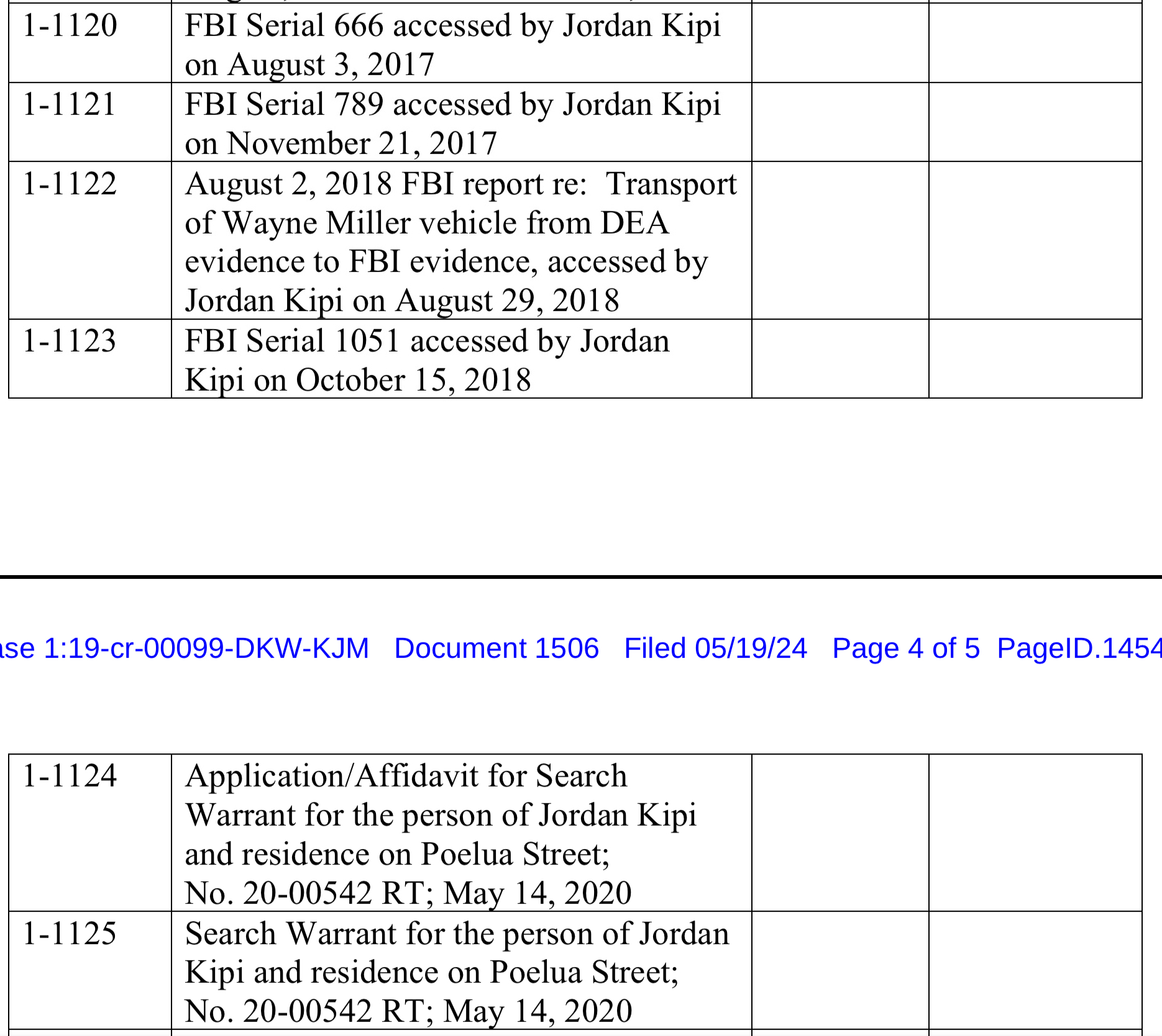
On Sunday, May 19, government attorneys had filed their 29th Supplemental Exhibit List, which contained several eye-catching items, including the application for a search warrant targeting the home of Jordan Kipi, then a surveillance specialist employed by the FBI.

Two search warrants targeting Kipi’s phone and home were inadvertently disclosed earlier, but this is the first public reference to them.

Watson then chided both sides over the increasing number of objections being raised, and told them to put their continuing objections in writing for him to consider. Watson said he would rule on the written submissions and would not take further arguments.

Then, during a break on Tuesday, Watson again blasted prosecutors for filing eight supplemental witness lists, naming additional witnesses to the more than 900 potential witnesses it originally identified. Watson said he was not sure where the government got the idea it would just add witnesses in this manner.

Watson said he would allow those additional witnesses named to date, but the government will have to file a motion if more witnesses are proposed and will be required to show “good cause.” And, Watson warned, they will have to meet a “high standard.”

On Wednesday, Angela Varnadore, a former employee who was once one of Miske’s girlfriends, was asked whether Miske had sources of information inside government agencies.

P: “Did Mr. Miske ever bring up his federal investigation to you?

W: “Yes.

P: “Did he ever bring up any law enforcement personnel that he knew?

W: “Yes, he said he knew people in local law enforcement, ATF, and FBI and that he would get information about the federal investigation from them.

This seems like it would have been a point to introduce one or more of the proposed exhibits related to Kipi, but the government appears to have been prevented from doing so by Watson’s earlier order concerning the supplemental exhibits.

Then on Thursday, after the jury was excused, Watson blew up at prosecutors again. After somewhat tedious questioning of witnesses over accounting records, he told prosecutors they need to streamline things. Watson said it had taken the 50 minutes to get information when it should have taken about 30 seconds, and he proceeded to suggest how he would have done it.

Watson called it “a colossal waste” of time for him and others. His parting shot was that if prosecutors didn’t streamline their approach, he would do it, potentially a warning that he would cut off excessive questioning. Watson then abruptly stormed out of the courtroom.

Despite getting on the wrong side of Judge Watson, prosecutors did elicit some telling testimony during the week. But it was unfortunately overshadowed by the reaction from the bench. Fortunately for prosecutors, the judge’s comments were not made in the presence of the jury.

Operation EM-EM put Mike Miske’s finances under a microscope

An FBI investigation launched in 2014 that led to the indictment of former Kamaaina Termite & Pest Control owner Mike Miske was dubbed “Operation EM-EM.”

The investigation was summarized in an initial document quoted by Miske’s attorneys last year in a series of court filings that unsuccessfully sought to suppress several search warrants and significant evidence they had produced.

According to Miske’s attorneys, citing records disclosed in discovery, the FBI’s Criminal Enterprise Squad launched Operation EM-EM on March 2, 2014, but it didn’t start from scratch.

The “new” investigation was “to re-focus on original subject of 245C-HN-20275, Mike Miske”, i.e.- the joint FBI/IRS/HPD Organized Crime Drug Enforcement Task Force (OCDETF) investigation which had been opened in 2008, which the FBI had titled “Waimanalo Blues Miske, Michael.”

“Following the FBI’s opening of “Operation EM-EM” to re-focus on Miske, the IRS transferred custody of bank records collected during Waimanalo Blues to the FBI, including KTPC bank records from as early as May 2008, through at least October 2013, as well as bank records from Mr. Miske’s other businesses,” according to a reply filed by Miske’s attorneys on October 6, 2023.

As part of the earlier Waimanalo Blues investigation, the FBI made several controlled drug buys and wiretapped at least two telephones, “each for an initial 30-day period and a renewal,” but failed to implicate Miske in the drug trafficking.

The IRS also collected “at least 70 banker boxes of financial records involving Miske and his businesses,” which were turned over to Operation EM-EM.

A federal investigative grand jury began issuing subpoenas for financial information from Miske’s banks and financial advisors in 2014, at the same time federal investigators were actively developing confidential sources concerning Miske’s involvement in gambling, drug dealing, and extortion.

The dimensions of the financial side of the investigation is suggested by these initial subpoenas.

• December 2, 2014: A federal grand jury subpoena was issued to Central Pacific Bank for records of Michael J. Miske from October 1, 2013 to the present. The bank produced minimal records which included a signature card of one account, which ha been inactive, and a signature card and 14 pages of bank statements covering October 2013 through November 2014.

• December 2, 2014: A similar subpoena was issued to First Hawaiian Bank, which produced records of six accounts. Four accounts were in Miske’s name. On account was for Miske’s living trust, with trustees identified as his mother, Maydeen Stancil, and Edward Freitas, who was married to Miske’s cousin. Five of the accounts had been closed in September and October 2014.

• February 25, 2015: A grand jury subpoena was issued to American Express for records from the accounts of Leverage Inc; M Night Club the Row Bar; Kamaaina Termite & Pest; Kamaaina Rolloffs LLC, including merchant paid listings, merchant applications, and merchant case notes,

• February 25, 2015: A subpoena was served on Bank of Hawaii for all records from January 1, 2010 to the present relating to Mike Miske’s accounts, including signature cards, wire transfer, checks and withdrawals, all statements, loan applications, financial statement submitted by Miske, disbursements and payment records, and any notes or memoranda written by bank officials regarding the accounts, and all credit reports.

• February 25, 2015: Records regarding Kamaaina Termite’s contract to fumigate cabinets in hundreds of apartments in the Keola La’i Condominium were subpoenaed from Nordic/PCL Construction. The subpoena included all documents regarding payments, all checks or wire transfers between Nordic and Kamaaina Termite, all written communications (electronic or handwritten), all contracts and related files, and the contact information of anyone involved in the project that was still employed by Nordic.

The subpoena instructed: “Do not disclose to any person the fact that you have received or
complied with this subpoena because prior disclosure could impede the investigation being conducted by the grand jury.”

• February 25, 2015: A subpoena was issued to the accounting firm handling tax matters for Miske and his companies. The company produced emails by March 25, 2015, and additional records by April 24, 2015. The company said it could not produce document from QuickBooks in the Cloud due to the subpoena’s requirement for confidentiality.

• July 9, 2015: Intuit responded to a grand jury subpoena for cloned copies of the Quickbooks Online accounts of Leverage Inc., Oceans 808, and Hawaii Partners LLC.

An earlier subpoena to First Hawaiian Bank, issued on October 11, 2013, sought records for ten Miske companies from December 16, 2010 through the present, including records of savings accounts, checking accounts, loans, safety deposit boxes, and credit cards. “GAG ORDER” is stamped on the subpoena in large letters. No information was included about any records actually produced.

Kamaaina Holdings LLC
Kamaaina Holdings Inc.
Kamaaina Termite & Pest Control
Leverage Entertainment LLC
Leverage Inc.
Hawaii Partners LLC
Kamaaina Hauling LLC
Kamaaina Rolloffs LLC
Kamaaina Capital LLC
Kamaaina Solar Solutions LLC

In March 2018, Operation EM-EM was converted into an Organized Crime Drug Enforcement Task Force investigation involving multiple federal and local agencies, documents show.

This appears to have occurred after Wayne Miller, once considered Miske’s #1 associate, disclosed to investigators that Miske had allegedly financed a July 2014 attempted cocaine buy in California.

The cocaine deal had been broken up by federal drug agents and local police. Miller and another man, Michael Buntenbah, had been detained but quickly released.

Miske and Buntenbah were secretly indicted on drug trafficking charges in July 2019. The indictment remained sealed until July 2020, when a 22-count superseding indictment expanded the charges and added 9 additional co-defendants, along with Miske and Buntenbah.

Miller was charged separately and pleaded guilty in December 2020 to conspiring with Miske and others to violate racketeering laws.