
Honolulu’s Board of Water Supply appears to be in more disarray than I thought.
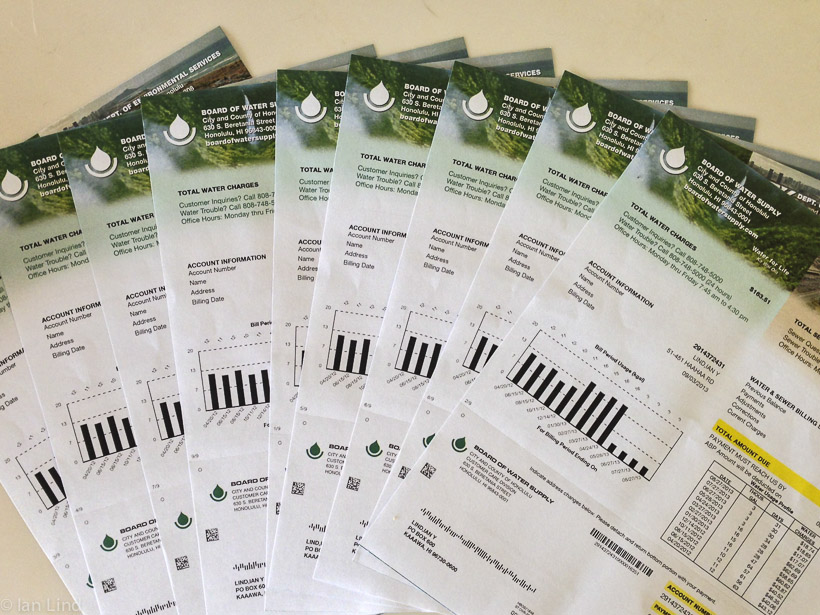 Yesterday we received a letter-size packet with 10 pages of materials from the BWS.
First, the cover letter, undated, address to “Valued BWS Customer.”
According to the letter, BWS “discovered situations where some bills were being estimated when, in fact, actual meter readings were available. For some customers, this may have occurred for more than one billing period.”
The letter went on to say that some people will end up owing more, some less.
Then there are recalculated bills attached “based on actual readings taken from your water meter.”
In our case, there were nine pages of bills for the periods beginning December 15, 2012 and running through August 27, 2013.
Remember they claim these are “based on actual readings.”
If I read the bills correctly, we end up owing an additional $163.51, but it took a bit of paper shuffling to figure out how this was calculated. That’s doesn’t seem particularly burdensome for the nine billing periods.
But there are huge red flags.
First red flag…although supposedly based on actual meter readings, our monthly meter readings were 16,000 gallons per billing period (usually about a month, give or take a few days, except for the first period, which was six weeks) from December 2012 through the end of April 2013. I have no idea how much water that is or if its a reasonable amount for us to use. But it seems odd that the use is so steady, despite differences in the number of days in the billing period, and whether or not we were traveling for a portion of the billing period.
Second red flag…from April 25 forward, the monthly use abruptly fell to just 3,000 gallons per billing period. Remember, they say this is from actual meter readings.
And it has remained exactly 3,000 gallons per month through the end of August, again regardless of the number of days in the duty period.
There’s nothing we know of to account for the dramatic 81 percent decline in measured use.
Something just doesn’t seem right.
And there’s more!
Third and perhaps biggest red flag…there’s a special note in the cover letter:
Special note: If you subscribe to Automatic Bill Payment (ABP), and each individual bill shows an amount due, then you can expect to see multiple deductions from your ABP account.
Fair enough, except that the series of bills carries a running total, and it’s the running total that shows up as the amount due.
So if, as the letter says, their automatic system is going to deduct each of the monthly “amounts due,” then it looks like we will be vastly overcharged, setting in motion a long, drawn out process to try and recover the excess charges.
Oh, but don’t worry.

Just call the BWS and “one of our helpful Customer Service Representatives will be pleased to assist you….”
Except that their customer service system has totally collapsed, telephone access is impossible, and promised return calls are never received.
Are heads going to roll over all this?
Also see: What’s going on at the Board of Water Supply? September 9, 2013.
Discover more from i L i n d
Subscribe to get the latest posts sent to your email.
First, I would recommend removing the auto pay from your account. It’s easy enough these days to set up online payments from a regular checking account, and they can be set in advance of due dates.
Second, if the 16,000 gallons covers five months, then that’s an average of 3,200/month, so going to 3,000 isn’t that far off.
As far as monthly usage, based on my experience and prior communication with the BWS, 3,000 gal./mo. sounds reasonable for two people if you water a lawn regularly. If not or if you are very conservative with your water consumption, e.g., low-flow toilets and showers, it might be too high.
Ian, I hope you may consider looking into whether Oahu’s largest private water customers are paying a “fair” share of the responsibility for delivering water to Waikiki hotels/restaurants, golf courses, power plants, refineries, new developments, etc…
One would suspect that it is possible that the convuluted billing system helps obscure fairness issues.
Are existing residential customers subsidizing the costs of water delivery to the largest private users and to new developments being planned all over Oahu?
How can these new developments be approved for water supply when the existing water delivery service has a break somewhere on the island nearly every day?
http://the.honoluluadvertiser.com/article/2001/Jul/28/ln/ln01a.html
“. . . whether Oahu’s largest private water customers are paying a “fair” share. . .” This is a really good point. At least some condo buildings have one water billing account. I was told they therefore pay only one “water billing charge.” Yet it seems likely that the customer services used would be much higher.
This was brought up during a council committee meeting and should be something that the auditor take a look at.
Well, condo owners don’t normally deal with the Board of Water Supply directly. They aren’t even BWS customers. The condominium owners’ association is the single customer, and water issues in a condo have to be dealt with by the owners association. I don’t see where BWS customer service issues would come up for condo dwellers.
I believe Natalie is talking about a condo association’s water bills relative to their total water usage – not “customer service” specifically. Theoretically the tall condos are big users.
Maybe it gets confusing because we’re not paying for the water itself right? I thought customers are actually paying for the service of having “X” gallons delivered per billing period…..
Which reminds me, do all property owners have a right to use as much water as they want each month?
Hmm. If that’s the case, I stand corrected.
I totally agree with Natalie. I NEVER use the auto bill pay for the simple reason that the company is going to deduct from your checking account whatever they say you owe, no matter how outrageous. There is no sanity check. Then, if there is an error, it is up to you to prove it and recover the money from them. Companies are not in the business of giving money back to customers so it is always an up hill battle.
Auto bill pay is sold as a convenience to the customer but it is more of benefit to the company. Even though it may be a little more work in the short run, I would rather examine my bill before I pay. If there is a discrepancy I can pay what I think I owe and then dispute the balance, all the while being firmly in control of MY money.
Natalie may be missing Ian’s point. Ian clearly mentions that the BWS claimed to have read his water meter every billing period – yet his usage remained constant. One can either assume that either the BWS was inaccurate – or Ian is extremely accurate in his water usage. I don’t think Ian is that lucky, if so, I’m meeting him in Vegas on his next trip there.
Ian, I had the same concerns, which I have had for a long time as a citizen, as ForPeople mentions above, as to the enormous amounts of water that one might assume are used by hotels, golf courses, etc. I recall receiving every now and then in the past some little device to lower the water used when one showers. Though I suppose hotels, etc., take some measures to conserve water, the use must be huge anyway. I don’t think I have ever read a news story about water usage, say, at hotels, as opposed to a typical family. As ForPeople stated, if residential bills at this point in time are not accurate, one wonders what happens with very large users of water.
That is a really good Honolulu Advertiser link that ForPeople posted if you care about long-term water security for Oahu. I agree that you have to wonder if everyone is paying their fair share for water. That is a question that should be explored. But the article lends itself to some other related issues that are also important.
This article does a great job of illustrating that it’s not just about the water that projects like Koa Ridge and Hoopili will use; it’s also about the water projects like these will block from being available to our island in the future.
From the July 28, 2001 Honolulu Advertiser story “O’ahu wells drying up fast” that ForPeople’s comment links to:
I don’t know how much rainfall will be diverted into the ocean by the cumulative effect of new land development projects over the next few decades, but I have noticed that this issue has been left out of many if not most news stories and discussions of those projects. The water that will be lost must have some value.
Okay, I see I did mis-read at least part of the post.
First, I didn’t realize that it was 16,000 gallons “per billing period.” How does that compare to the same time the prior year?
Going from 16,000 to 3,000 gallons per month does seem rather odd. The fact that the bills have consistently shown 3,000 gals./mo. recently wouldn’t bother me too much. Our bills are usually pretty consistent as well.
Scratch the surface of any local government operation in Hawaii and you’ll find some kind of a racket.
In ways you can’t even begin to imagine, the fix is in. Always. You know it, I know it, everybody knows it. And we all know that nothing will be done about it.
‘Asswhy we call it a unique island culture.
That’s nonsense!!
Succinctly put! Thanks.
Jim, I don’t believe we have met or talked, but what particularly is nonsense? Is it that A.Nonymous’s remarks were simply too broad? If so, in general how do you see government here?
Ian’s post raised issues (particularly in his red flags comments) of at least incompetence so gross that Ian asks, “Are heads going to roll over all this?”. Ian’s comments resulted in comments by others of possible intentional unfairness.
As to the remarks of A.Anonymous, even if sweeping, I can understand how they come about. I have certainly seen myself and heard, from persons with knowledge, of state officials and employees giving themselves and/or their friends basically unwarranted financial benefits, in one way or another, and, as far as I can tell, this is/was way more extensive and common than one could possibly imagine or expect, and much of it is in fact extraordinarily crafty. I had said to myself a number of times in the past that if we somehow learned of all the “schemes” that go on and their pervasiveness, the folks in the state would have a collective heart attack.
And, as far as incompetence goes, how much of that is due to hiring friends and relatives (a common practice–note that the Legislature will not pass a nepotism bill–I introduced one long ago) who do not have the proper skills, or intentionally assigning government employees to do tasks they can’t competently perform in order to give “friends” benefits of some kind, sort of by default, so to speak?
To what degree is money appropriated for certain government functions diverted to again give friends and relatives or oneself unwarranted financial benefits?
As to what I saw, I did as much as I could to address the situations I learned of, while I worked at the Hawaii State Ethics Commission, a place itself that at times did not hesitate to quash the investigations of friends/relatives, or took minimal action as a guise for avoiding more appropriate action–again for friends/relatives.
I once asked an FBI agent which government was more corrupt–Chicago, New Orleans, or Hawaii. He thought for awhile, and said he really could not say, implying that all three were about the same. I once talked to a retired Honolulu city finance director who told me his task as assigned by a mayor, as I recall, was to explain to potential contractors how to give kickbacks without saying anything that would incriminate them in the process. A developer told me once how he would walk brown bags of large sums of cash down Bishop Street for the benefit of a government official.
Over the years, I have been told by government officials a few times how they refused envelopes of cash–and there was no issue here of whether cash was in the envelopes or not. One told me of his refusal to purchase a house offered by a developer at a highly discounted price. The official also stated an offer was then made to sell the house to the official’s sister, to hold it form him until he left office. He declined this as well.
I heard of these clearly corrupt activities usually long after anything could be done (though I certainly had enough to do while working at the Hawaii State Ethics Commission).
Certainly many areas have improved over the years, and one hopes that in general things are getting better. But I would be hard-pressed to believe that an awful lot of corruption does not continue, and that it is difficult to say that intentional favoritism is not rampant.
I am amazed at the level of incompetence that currently goes on in government, and the lack of many government agencies to, at all, return calls, respond to emails, send what they say they will send, and so forth, despite advising one to leave voice messages, send in emails, and so forth. For almost four years now it seems the only way to deal with many government agencies is to spend the time and money to make a personal appearance–and these are critical agencies.
I should mention that I believe the overwhelming majority of government workers are competent, do fine work, and are eager to do fine work. It seems these people as well for one reason or another are unable to do the jobs they would like to do.
As a proposal, in this day of websites and the Internet, I don’t think it would be too much to require government agencies to put their budgets on their websites, along with how the money is used. I am not suggesting exhaustive detail, but a fair picture, in the name of transparency (and democracy). Would it be so difficult to scan minutes of board meetings as well on to such websites? Yes, this would take some time and effort, but I believe that things would quickly improve, thereby saving government money in the long run, and providing the people of Hawaii with confidence in its government. Agencies can do this voluntarily with their public information–laws do not have to be passed.
The comment by A.Anonymous may have been extreme, but it seems to me to capture more of the truth of what is happening than assumptions of the opposite.