Category Archives: Campaigns

Top labor picks this campaign season

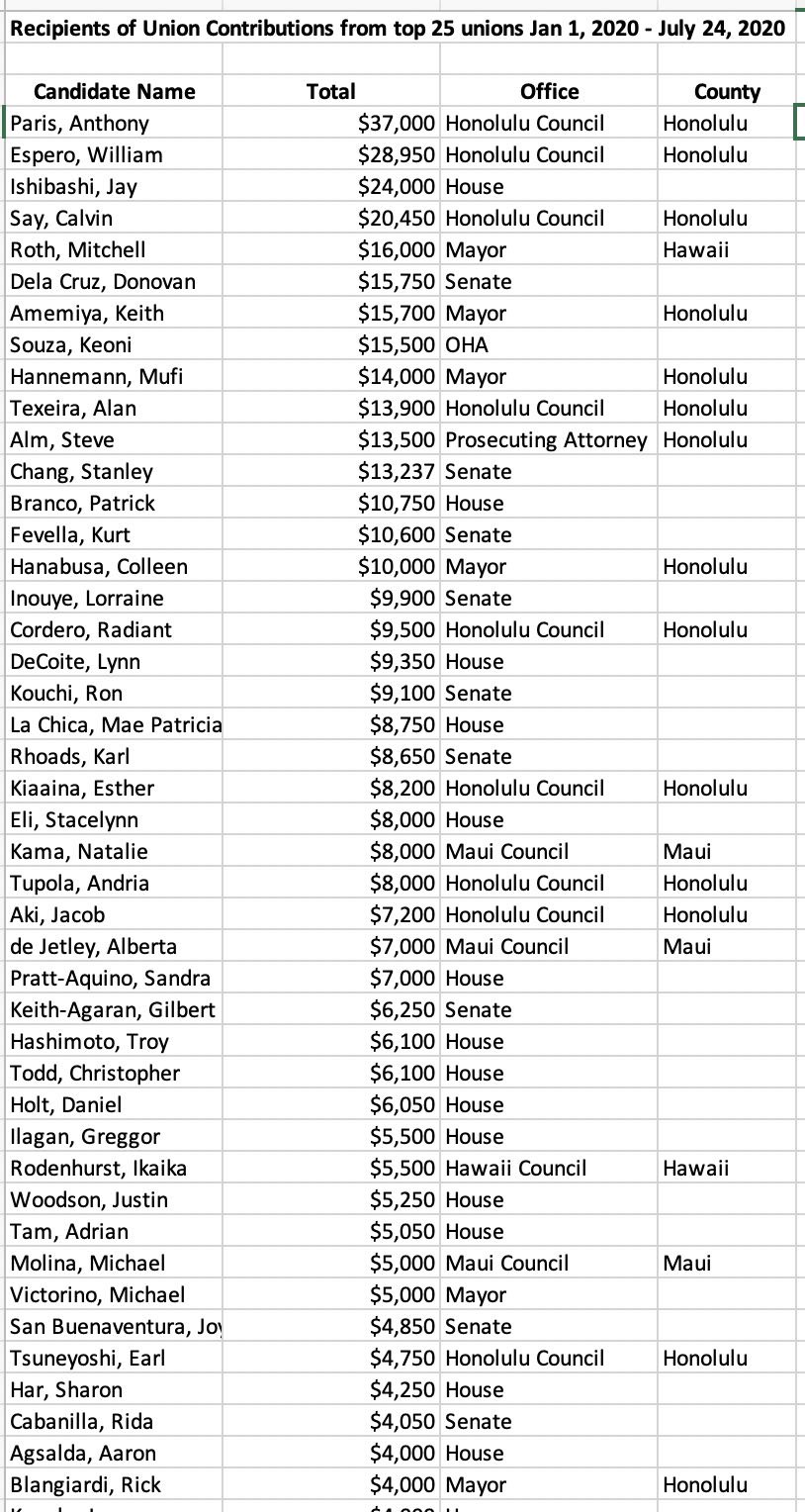
Here’s a quick-and-dirty profile of where labor union money is going during this campaign season.

What I did here was to rank the top contributors to candidates during the period from January 1, 2020 through July 24, 2020. I then selected the unions that devoted the most money to candidates, sometimes through various related union entities.

The result is a list that may have a few errors, but identifies those candidates that have drawn the most union funds. Even though these data haven’t been double-checked and cleaned up, I think it provides a pretty fair look at the situation.

Union backed candidates 2020

Since you asked….

Well, I cast my primary election ballot, with two Honolulu county offices at the top of the ticket.

I don’t usually talk about my personal choices at election time, because these choices are just that. Personal. And this year, none of the top contenders struck me as unusually noxious, but neither did any generate real enthusiasm.  But I’ve been asked by several acquaintances, so here were my choices in the two top races.

In the end, I voted Colleen Hanabusa for Honolulu mayor.

Rick Blangiardi and Keith Amemiya both suffered, in my view, from a lack of public experience and, more importantly, thorough vetting. Their professional experiences have really been presented to us as part of their campaign public relations, and with the weakend state of our local news media, neither has really gotten the tough background checks they deserve.

Mufi has shown he can can do the job. That part of his pitch is true. He has also shown himself to capable of being a political and personal bully at one moment, then turn around and be warm and charming. Yes, he has experience. But I continue to blame Honolulu’s rail fiasco on the short timeline he insisted on during its planning and approval phases, which was necessary so that he could run for governor with the shiny new train as his campaign centerpiece. But when he left office for that unsuccessful campaign, he left us holding the bill. And we’re still paying it.

In addition, while the public seems to have realized that ten million visitors per year is more than our collective infrastructure, both physical and cultural, can reasonable absorb, Mufi has spent the last decade immersed in the hospitality industry. I just don’t see that he can turn on a dime and deal with his friends and patrons as we attempt to find a way to downsize the industry without crippling our economy.

In the end, I voted for Colleen. She’s been around, built a record in the legislature, stayed out of the danger zone when she went off to Washington. She’s tough, and she’s been in some political fights,  and not just because she’s from Waianae. She has broken new ground for women during her career, and as a lawyer has represented working people and their labor organizations.  I admire those things.

I have to trust that if she is successful this time around, she’ll serve out her term(s) as mayor without worrying about opportunities for higher office. She has said that this is it. I voted to give her the chance.

For Honolulu prosecutor, in the end I voted for Steve Alm. I finally was convinced he has the depth of experience–U.S. Attorney, judge, criminal justice consultant–to be dropped into the prosecutor’s office and the turmoil it has experienced over several years, and deal with the mess he’s going to find there. He won’t be pushed around. At the same time, he has an appreciation for the human side of our criminal justice system, and has put himself on the line in the past to promote better ways to treat those charged with criminal offenses. Even if those experiments didn’t always work as well as we hoped, I give him credit for doing his best to break out of the box. I think he’ll do a good job for us.

I did like Jacquie Esser’s campaign message, but I ended up feeling like she needs more experience to handle the bureaucratic and political snakepit that the prosecutor’s office appears to be. With a bit more experience, she has the potential to be a formidable candidate.

Voting is important. But equally important is what we do between elections. In the past, I’ve reported critically on some of the people I voted to put into office. That’s just how it works. I vote to give them the opportunity to serve, and then have to hold them accountable for how the job is done.

And unless one of the mayor candidates manages to hit that 50% mark, which looks unlikely at this point, we’ll all have to revisit our choices going into the General Election in November.

Occupation: Domestic Goddess

It isn’t often that you run into a bit of humor while reviewing reports of campaign contributions and expenditures filed with the State Campaign Spending Commission.

But…while going through last week’s filings, I noticed something in reports filed by the campaign of City Council member and mayoral candidate Kymberly Pine which provided me a chuckle.

Candidates and their campaigns are required to disclose the name and address of each person contributing more than $100, plus employer and occupation of anyone whose contributes a total of more than $1,000.

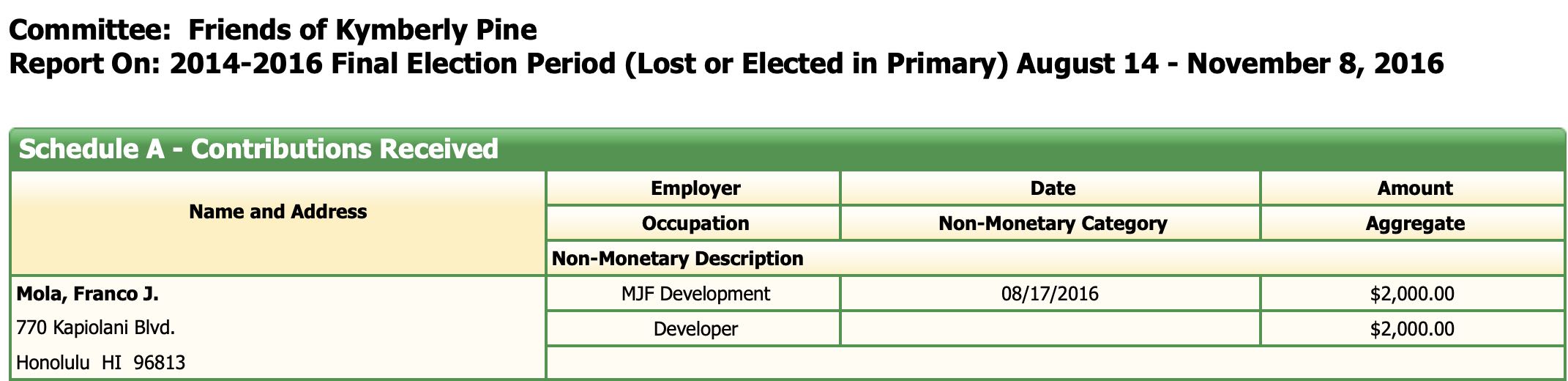
Buried among contributions received in that latter part of 2016 was this item, a $1,000 contribution from Renee Mola of an Austin, Texas address.

And there it was. Occupation–Domestic Goddess.

If the print is too small to read, click for a larger version.

Renee Mola is married to Franco J. Mola, whose $2,000 contribution to Pine’s campaign appeared in an amended report from the same period.

Franco Mola is a developer, listed in state business registration records as CEO of MJF Development and president of Coastal Rim Properties, which have projects in Pine’s district.

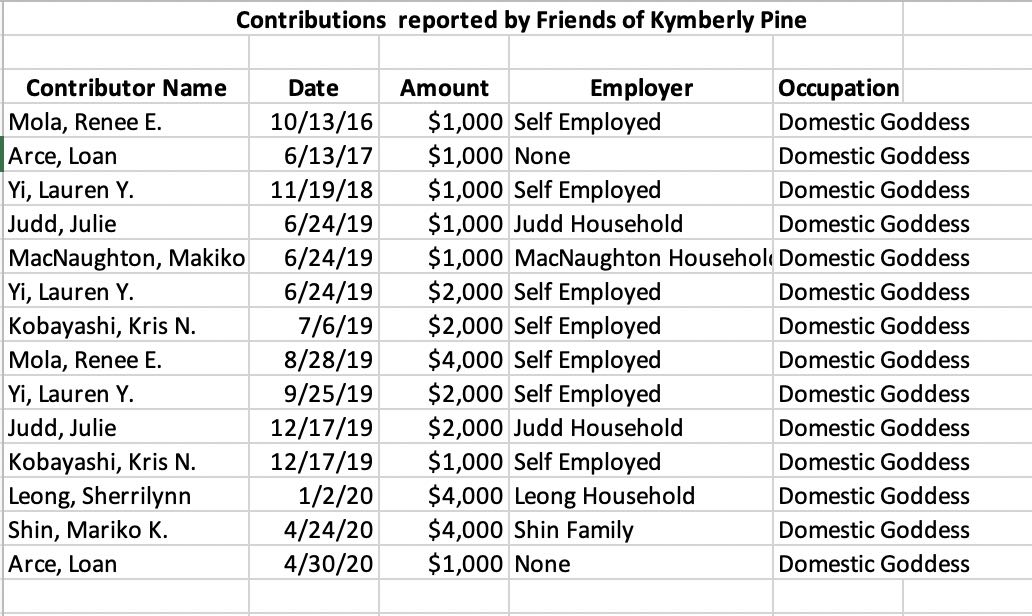
A further search of Pine’s records found the “Domestic Goddess” label had been applied to 14 contributions by eight women between 2016 and the latest report last week.

All appear to be wives or partners of prominent men.

In any case, thanks to Kym Pine for adding a bit of levity to an otherwise tedious task.

New budget director’s campaign contributions show he was no stranger to politics

Last Monday, the power Senate Ways and Means Committee voted 7-4 against the appointment of Craig Hirai, Governor David Ige’s nominee to head the Department of Budget and Finance.

But on Friday, the full Senate voted unanimously in support of Hirai, whose appointment will run until December 5, 2022.

Hirai has been serving as the acting Director of Finance.

His background is summarized in the Senate WAM committee report:

He previously served for six years as the Executive Director of the Hawaii Housing Finance and Development Corporation, and has also served as Chair of the State Rental Housing Trust Fund Commission and Chair of the 2001-2003 State Tax Review Commission. Mr. Hirai has a Master of Science Degree in Accounting, a Master of Business Administration Degree, and a Master of Laws in Taxation Degree. Mr. Hirai is a certified public accountant with a permit to practice in the State of Hawaii and is an inactive member of the Hawaii State Bar Association. Mr. Hirai also has forty years of experience as a tax accountant and tax attorney in the State.

Hirai was also registered as a lobbyist for the Hawaii Association of Realtors between January 17 and December 31, 2013. Previously he had been a member of the realtor’s Legislative Committee.

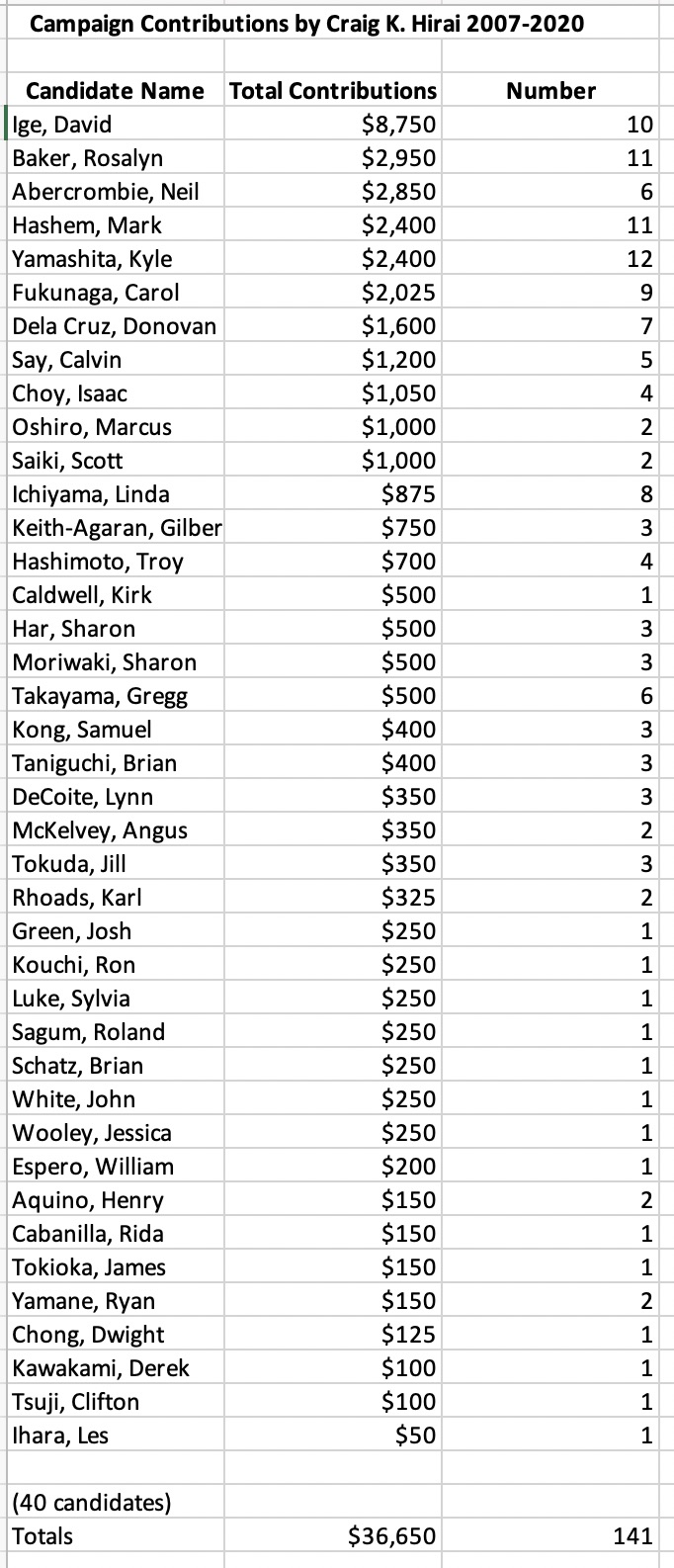
What the committee report doesn’t mention is that Hirai has also been a political player and a frequent contributor to political campaigns. Hirai has contributed a total of $36,650 to candidates between May 2007 and June 30, 2020, mostly Democratic legislative candidates or elected officials.

The majority of Hirai’s contributions were $250 or less, and were spread among 40 different candidates.

Hirai contributed a total of $8,750 to David Ige beginning with $250 in August, 2011, and including six contributions of $1,000 or more between 2014 and 2018.

My guess is that Hirai attended political fundraising events in order to build his networks and stay in touch with legislators and lobbyists. With the exception of his larger contributions to Gov. Ige, none were large enough to indicate that he was attempting to gain special access or influence.