
Category Archives: Consumer issues

What about the First Amendment?

Civil Beat’s “Sunshine Blog” threw it’s weight behind House Bill 371, proposed legislation described as “the measure that would ban the owners, officers and close family members of government contractors and organizations that receive state grants in aid from donating to political campaigns.”

Apparently CB sees it as a way to put an end to pay-to-play politics.

A worthy goal.

However, in my view, CB and the Sunshine Blog are making a grave error in not taking into account the First Amendment implications of this bill.

The sweeping scope of this bill and its restrictions on First Amendment political speech is breathtaking. Despite this, the legal issues surrounding free speech in the context of political campaigns and campaign finance were not mentioned in any of the testimony during hearings on this bill.

That’s a huge omission because, if passed into law, HB371 would not simply “chill” free speech of corporations, it would eliminate the First Amendment rights of an large but as-yet-undetermined number of individuals associated with , and would trample on long-accepted legal precedents.

These issues are so glaring that the bill appears written to invite a successful First Amendment legal challenge.

Back to Basics

What happens when there’s a direct conflict between the First Amendment right to free speech during an election campaign, and the public’s interest in combatting corruption?

Political speech and expression are at the heart of the First Amendment. After all, the First Amendment’s primary purpose was to protect open discourse about government affairs. Thus, political speech usually receives the strongest protection.

This means that courts tend to apply strict scrutiny to test the constitutionality of restrictions on political speech or expression. Strict scrutiny is the most difficult standard to meet. It requires a restriction to serve a compelling government interest in the least restrictive manner.

A compelling government interest, implemented in the least restrictive manner, or at least in a narrowly targeted manner.

So let’s take a look at HB371.

It would prohibit contributions by state or county contractors, as well as state or county grantees, along with their officers or immediate family members, whether or not they have any role in the contracts or grants, or even any contact with the family member directly involved.

And immediate family members, according to the bill, includes any child, parent, grandparent, brother, or sister, and the spouses or reciprocal beneficiaries of those officers.

I haven’t seen any discussion of the loss of rights for officers of state grantees, along with their family members.

Check this list of organizations that received state grants in aid during the 2024 legislative session.

Here’s page 1 of the 4-page list of grant-in-aid recipients, just to provide a sense of the bill’s broad impact.
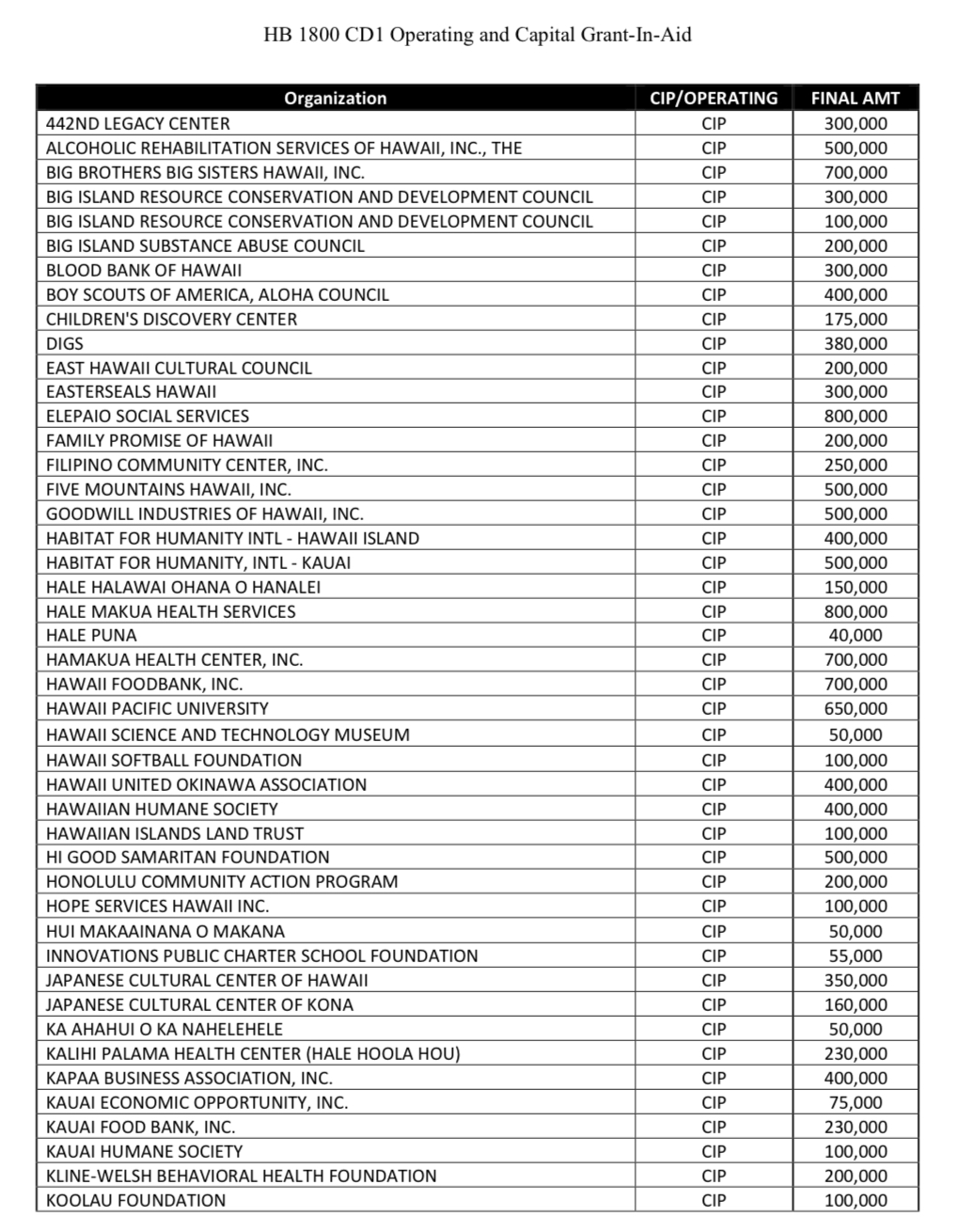
Somewhere about 150 community nonprofit organizations are on the list. And all of their officers, along with their parents, grandparents, siblings, and their spouses or partners, will not only be prohibited from contributing to the candidates of their choice, but from contributing to “any political committee,” or to “any person for any political purpose,” or to solicit any contribution “for any purpose.”

One glaring omission is the lack of any nexus between these sweeping prohibitions, the contracts or grants that trigger them, and any actual potential for corruption stemming from those contracts or grants.

For example, an argument can be made that a corporate contractor or grantee, and its officers, should be prohibited from making campaign contributions to the level of government that originates the contract or grant. So you get a state contract, and you shouldn’t then contribute to the governor. But why should that state contract limit your ability to contribute to the mayor’s race, or a city council race, when those positions play no role whatsoever in awarding the contracts or grants?

At one point, my father’s small restaurant supply company competed for contracts to equip school kitchens. If he had landed any of those contracts, my political rights would have been eliminated, along with those of my wife, despite there being no crossover between my dad’s Republican leanings and my own political views.

It seems to me that this is classic overreach, and far from the targeted restrictions that First Amendment analysis requires.

There are already plenty of laws prohibiting pay-to-play corruption. It’s illegal to enter into explicit or implicit quid-pro-quo understandings linking campaign contributions to discretionary action by an elected official. It’s illegal to structure campaign contributions in order to evade contribution limits, by giving money to others (employees, relatives, friends, customers, etc) that they would then contribute in their own names.

Obviously, a narrowly-targeted approach to clamping down on pay-to-play would be to substantially increase the budget for investigation and prosecution of these crimes, and they are crimes, or perhaps to prohibit all contributions by corporations to state and local candidates, as is done at the federal level.

Those are approaches which do not get into the thorny area of restricting constitutionally protected rights.

In any case, this is a discussion that hasn’t happened during the consideration of HB371.

There is also a broader issue. How do we see the political arena? Is it a system in which conflicting special-interest groups clash in a complex dance of deals, accommodations, and tradeoffs, or one in which the goal is to eliminate actual “interests” and leave decisions to neutral arbiters of the “public” interest?

But that is necessarily a discussion for another day.

Oregon county officials blasted for Hawaii junkets

Winter isn’t over here in Portland, with weather still dominated by cold, gray, and wet days. So a report that some area public officials have been flying to Hawaii once or twice a year at public expense on previously undisclosed trips makes for a good headline story!

See: “How Washington County sewer officials scored annual Hawaii trips and 5-star lodging.”

The Oregonian newspaper and OregonLive.com have been skewering the members of Oregon’s Washington County sewer agency for undisclosed annual trips to Hawaii.

At least eight people with ties to Washington County’s sewer agency have traveled to Hawaii for business conferences in recent years, staying at an assortment of five-star resorts across several islands offering breathtaking views of the beach and ocean.

Those trips aren’t accounted for in the agency’s annual budgets even though ratepayers of Clean Water Services indirectly footed the bill.

Three of the group trips to Hawaii cost a whopping $91,000 and, in some instances, government officials received first-class airfare, premium hotel rooms or fine dining, an investigation by The Oregonian/OregonLive has found. Officials made four other trips at an undisclosed cost.

It’s not uncommon for government workers in agencies large and small to attend out-of-state conferences to learn about and keep tabs on industry best practices. But what makes the Hawaiian excursions unusual is their frequency, cost, lack of transparency – and that the recurring tropical location is the result of a local business decision made by design.

Washington County is part of the Portland Metropolitan Area, home to several cities including Beaverton, Hillsboro, and Tigard.

The county’s Clean Water Services department formed its own captive insurance company in 2016, and chose Hawaii as the new insurer’s headquarters due to the state’s captive insurance program that counts more than 270 captive insurance companies on its rolls.

These closely-held insurers are most often set up by corporations. In 2016, the year that the county established its “captive” ih Hawaii, Oregon law reportedly didhot allow “public entity not-for-profit captives,” although there is some dispute over whether that was actually the case.

But by establishing its captive insurance company in Hawaii, the sewer agency was required to hold their annual board meeting in the islands.

The Oregonian reported that Hawaii touts its location as a benefit.

“If you are forced to go to Hawaii once a year to have a board meeting that’s paid for by the company, it’s usually not a bad thing from most people’s perspective,” Ryan Keeling, a financial analyst with Oregon’s Department of Consumer and Business Services, which oversees the state’s own captive insurance program, said wryly.

The story seems to have legs, as they say, and it has appeared in promotional emails by OregonLive throughout the week.

It makes me wonder how many other interesting stories might be found among Hawaii’s 270+ captive insurance companies.

Tariffs on Canadian products to hit newsprint

If Trump’s tariffs on Canadian products goes into effect as threatened, one of the immediate victims will be America newspaper publishers, who are reliant on Canadian newsprint.

According to a recent story in the Columbia Journalism Review:

Canada has long been a major supplier of American newsprint—it now provides an estimated 80 percent of the paper used by US newspapers. A tariff would add a significant burden to publishers already struggling with high costs of production and thin margins, and analysts say the mere looming threat of one has complicated life for printers. “There is no scenario under which this is cost-positive for the media industry,” said Brett House, a professor of professional practice at the Columbia Business School. “Almost anything that is done here is going to be increasing prices for newsprint.”

John Galer, the publisher of the Journal-News in Hillsboro, Illinois, said the new tariffs represent more than just a financial setback. He publishes eight newspapers and prints nineteen other publications at his press, serving rural communities that often have no other dedicated source of news. His publications rely entirely on Canadian newsprint, and he estimates a 25 percent tariff would increase his costs by about twenty thousand dollars a year, forcing him to increase his prices. “I like to stay hopeful,” he said. “But right now, we’re all just waiting to see what happens next.” (Galer learned of the postponement of the tariffs from a text message as we were speaking on the phone. “I don’t get it,” he muttered.)

Trump, who has no love for newspapers and their nosy reporters, may welcome the demise of more newspapers as a result of the increasaed cost of newsprint.

Carpenter Media Group owns the Honolulu Star-Advertiser and MidWeek, as well as newspapers on Kauai and Hawaii Island, which are among about 250 papers the company holds in the U.S. and Canada, many in the southern states of including Texas, Louisiana, Mississippi, North Carolina, Tennessee, Georgia, Virginia and Kentucky.

The impacts are likely to include continuing staff cutbacks across the industy, increases in subscription prices and a resulting decline in print readership. None of this is good news for already struggling newspapers.

Martha Diaz Aszkenazy, chair of the National Newspaper Association, told CJR that the uncertainty has been hitting newspapers even before the tariffs go into effect.

“It’s affecting our customers who are, for instance, holding back from making decisions about advertising,” she said.

“I just don’t know why we are doing this,” she said. “It seems like instead of making America great, we’re just making America scared.”

They’re going after our libraries

Now they’re coming for the libraries and the librarians! Museums, too.

Following attacks on universities and colleges, and elimination of the Department of Education, there’s definitely a theme to these assaults on institutions of learning.

On Friday night, DLT signed another executive order calling for the elimination of the Institute of Museum and Library Services, the nation’s only federal agency for America’s libraries. This one hits close to home for most families and communities.

“IMLS is an independent federal agency that supports libraries, archives, and museums of all kinds in every U.S. state and territory. Funding for IMLS is authorized by Congress through an annual appropriations process,” according to the website Ilovelibraries.com. “In 2024, IMLS provided $266.7 million to America’s libraries, museums, and cultural institutions through grants, policymaking, and research.”

Americans have loved and relied on public, school, and academic libraries for generations. By eliminating the only federal agency dedicated to funding library services, the Trump Administration’s executive order is cutting off at the knees the most beloved and trusted of American institutions and the staff and services they offer, including early literacy development, summer reading programs for kids, high-speed internet access, employment assistance for job seekers, braille and talking books for people with visual impairments, and so much more.

The American Library Association issued a statement.

Americans have loved and relied on public, school and academic libraries for generations. By eliminating the only federal agency dedicated to funding library services, the Trump administration’s executive order is cutting off at the knees the most beloved and trusted of American institutions and the staff and services they offer:

Early literacy development and grade-level reading programs
Summer reading programs for kids?
High-speed internet access
Employment assistance for job seekers?
Braille and talking books for people with visual impairments
Homework and research resources for students and faculty
Veterans’ telehealth spaces equipped with technology and staff support
STEM programs, simulation equipment and training for workforce development
Small business support for budding entrepreneurs

To dismiss some 75 committed workers and mission of an agency that advances opportunity and learning is to dismiss the aspirations and everyday needs of millions of Americans. And those who will feel that loss most keenly live in rural communities.?

As seedbeds of literacy and innovation, our nation’s 125,000 public, school, academic and special libraries deserve more, not less support. Libraries of all types translate 0.003% of the federal budget into programs and services used in more than 1.2 billion in-person patron visits every year, and many more virtual visits.

The American Alliance of Museums is providing updates on the developing situation.