
Category Archives: Economics

CMBS could pose risks for some Hawaii’s hotels & retail properties

CMBS. Not exactly a familiar acronym to most of us. It stands for collateralized mortgage-backed securities, which refers to the repackaging of the underlying mortgages beneath hotels, shopping malls, and other large properties to create securities which are then sold to investors, offering a way to finance debt beyond the relative safety of plain vanilla mortgage loans.

Hawaii hotels are sitting on billions of dollars of CMBS which are subject to debt service payments and eventual repayment of the principal amounts. But the current lockdown of Hawaii’s tourism industry could leave many facing difficulties making required payments.

Back in early March, prognosticators were suggesting Hawaii’s visitor industry could see revenue declines of 15-35% this year due to the COVID-19 pandemic. Under those scenarios, Hawaii’s tourism-based industry was rated likely to weather the financial storm, with perhaps a couple of shaky properties.

But a virtually total shutdown of the entire industry for an extended period of time, with no clear path to full reopening, doesn’t just mean a high level of unemployment among hotel, restaurant, and retail employees.

The danger, of course, is if hotels may be unable to cover their debt service payments and default, especially if Hawaii’s lockdown is prolonged. With revenues down to zero at this time for most Hawaii hotels and resorts, it’s hard to imagine that there isn’t a lot of fear and trembling behind the scenes.

Pacific Business News called attention to the problem in a March 31, 2020 story.

In a March 27 letter addressed to a host of federal regulators, the heads of the American Hotel and Lodging Association and Asian American Hotel Owners Association said the industry’s “unprecedented cash flow crisis” brought on by the COVID-19 pandemic requires a separate financial lifeline as well as special protections from the sector’s legions of lenders and loan servicers….

“Many hotels are unable to pay operating costs and thus debt service,” wrote AHLA President Chip Rogers and AAHOA President Cecil Staton in their letter to the U.S. Treasury, Federal Reserve and Securities and Exchange Commission. “This will cause a snowball effect of foreclosures followed by lenders taking ownership of severely distressed assets with no ability to operate them.”

“Hotels in the Urban Honolulu area owe more than $2.2 billion in outstanding debt, and those in the Kahului-Wailuku-Lahaina MSA has nearly $750 million in outstanding CMBS debt,” PBN reported, pointing to 17 properties in Honolulu and another 7 on Maui with outstanding CMBS debt exposure.

A March 2, 2020 report by the Kroll bond rating agency also assessed the situation in Hawaii.

“Hawaii is home to 18 lodging properties—$4.33 billioin by allocated loan amount (ALA)—that serve as collateral for 17 loans securitized in 25 CMBS transactions. Additionally, there are 28 retail properties, inclusive of mixed-use assets with a significant retail component, collateralizing 28 loans ($2.95 billion) in 30 securitizations.”

Kroll then examined scenarios what would happen under “stress” where hotels were hit with drops of 15%, 25%, and in the worst case considered, 35% declines in business.

The report found only two properties, the Four Seasons Resort Hualalai and Waikiki Beach Marriott Resort & Spa, would not have the cash flow to cover debt obligations under at least the worst case scenario (a 35% decline). But if the same review were done today, it’s unclear whether its conclusions would be so sanguine.

Back in 2017, data published at Trepp.com, which maintains what it says is the largest commercially available database of securitized mortgages, listed two Hawaii resorts as among the five highest valued properties backed by securitized debt transactions.

The Hilton Hawaiian Village was ranked #2 by Trepp with a value of $2.23 billion.

Overall, the borrower’s fees and leasehold interest in Hilton Hawaiian Village anchors $1.275 billion in CMBS debt that is securitized in the single-asset HILT 2016-HHV deal, along with eight other conduit transactions. The fixed-rate mortgage is split into 16 pari-passu A-notes totaling $696.6 million and five B-notes with a combined balance of $578.4 million that were used for the refinancing of an existing $1.255 billion debt package.

And the Four Seasons Resort Maui at Wailea followed at #5 on Trepp’s list. The resort, with an “as-is” appraised value of $910 million (in 2017), “secures $600 million in debt that consists of a $469 million CMBS loan and two mezzanine notes totaling $131 million,” Trepp reported.

With high occupancy rates, these mega-resorts were projected to have little trouble covering their debt payments. However, with zero occupancy for an extended period, many others could be facing cash flow problems.

I’m less than comfortable making sense of the risks ahead as a result this kind of high financial stress. As they say, however, there be dragons.
What’s different this time around?

I’m not sure whether having lived through a series of somewhat similar crises helps or hurts understand and cope with the current coronavirus craziness.

We were around as the world dealt with SARS, H1N1, Ebola, as well as the Black Monday stock market crash in 1987, and the meltdown in 2008-2009.

I can especially recall the 1987 stock market crash, where more than 20% of the market’s value disappeared in a single day of trading. Meda and I arrived early for a presentation on the UH Manoa by a visiting history professor we had gotten to know. When we arrived, he had just gotten off the phone with his son on the east coast who called with news of the stock market crash.

As we stood in the hallway, our friend mused, “I wonder what happened to professors during the great depression?”

The question just hung in the air, since there didn’t seem to be anything any of us could do.

And somehow we survived. The macro disruptions were greater than those that we felt directly.

This time feels different. I’m probably more anxious about the economic impact on Hawaii by the current disruption of travel than by the health threat of the coronavirus, although we’re in that demographic group of 70-somethings considered at high risk, and perhaps I should be more worried about our mortality.

But the state is still over-dependent on tourism, and a major disruption will drag down all parts of the state budget. We can hope it will only last a couple of months, but I fear the impact could be prolonged on all the businesses and individuals who exist down the travel industry food chain.

So we’ll hunker down and hope for the best, while waiting for some better clues about how long this is going to last.

Was it a coincidence that I was browsing through thousands of photos I’ve uploaded to Amazon and Google, and there was an old B&W snapshot of my dad and my maternal grandfather clearing the area behind my parents house for a late 1941 or early 1942 “Victory garden,” a response to the disruptions introduced by the beginning of WWII.

Meanwhile, we’ve cancelled two planned trips that we had planned over the next couple of months, and are waiting to make a decision on #3. Of the small groups of friends we see on our early morning walks, three have already cancelled or are in the process of cancelling trips they had planned to take between now and the end of April. Two friends in California have each cancelled multiple trips, foreign and domestic.

There’s going to be plenty of pain to go around, it seems.

More on my parents’ 1942 home purchase

Just a few more then-now cost comparisons.

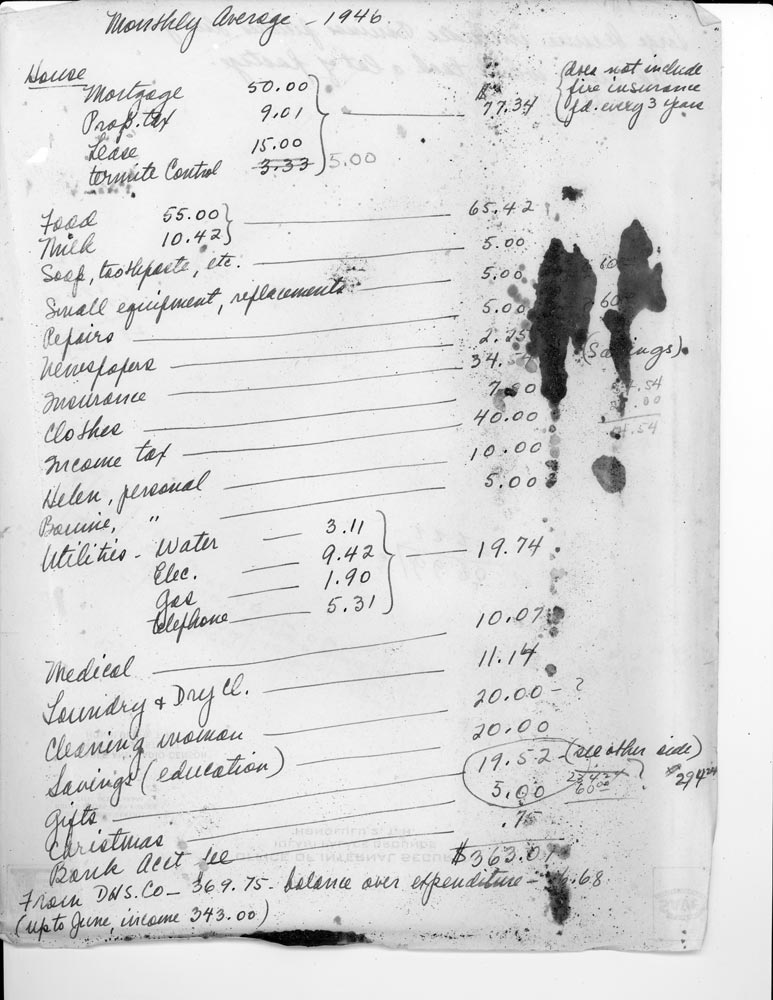
My mother kept meticulous household records, including this summary of average monthly costs during 1946, several years after they moved into their new house.

Just click to view a larger version.

She listed the major housing costs which I’ve excerpted below, with the current inflation-adjusted value in parentheses. These totaled $1,052.16 per month in 2019 dollars.

You can compare these to your monthly housing costs and draw your own conclusions.

Mortgage $50.00 ($688.09)

Property Tax $9.01 ($123.99)

Lease $15.00 ($206.43)

Electricity $9.42 ( $25.30)

Water $3.11 ( $8.35)

Second, although the figures posted here yesterday accurately reflected the original purchase price of the house, I realize they didn’t provide the whole story of the comparison to values today.

Why? The house was on a lot leased land, which reduced my parents initial investment. But the total shown here yesterday failed to include the eventual cost of buying the fee simple interest in the 11,250 square foot lot.

Initially, the land was owned by the what was then known as the Bishop Estate, which had subdivided areas around the island for leasehold residences.

Then in the early 1980s, Bishop Estate extended an offer to sell the land in fee to existing owners. Lease rents had been rising as older lease periods expired or reached periodic renegotiation dates. Monthly lease rents were quickly becoming prohibitively expensive for many families. It didn’t take much discussion for my parents to decide to take the Bishop Estate offer.

The cost in May 1982 was $77,100. That was the equivalent of $207,112.49 in today’s inflation adjusted dollars.

Added to the original purchase price of the house, the house-land total price, in today’s dollars, was about $297,489.95.

That’s still modest compared to Oahu’s median home price of $789,000 for the 12 month period ending October 31. The median means that half of the homes cost more, and half cost less.

But it’s not as dirt cheap as yesterday’s post would lead you to believe.

Do investments in farm lands make things better or worse for farmers?

Here’s a juxtaposition I find deeply disturbing.

On the one hand, there have been a spate of recent news stories about the dismal circumstances of farmers in the United States.

Here’s one which appeared in Time this week: “‘They’re Trying to Wipe Us Off the Map.’ Small American Farmers Are Nearing Extinction.”

The article starts with the story of a Wisconsin family.

The Rieckmanns are about $300,000 in debt, and bill collectors are hounding them about the feed bill and a repayment for a used tractor they bought to keep the farm going. But it’s harder than ever to make any money, much less pay the debt, Mary Rieckmann says, in the yellow-wallpapered kitchen of the sagging farmhouse where she lives with her husband, John, and two of their seven children. The Rieckmanns receive about $16 for every 100 pounds of milk they sell, a 40 percent decrease from six years back. There are weeks where the entire milk check goes towards the $2,100 monthly mortgage payment. Two bill collectors have taken out liens against the farm. “What do you do when you you’re up against the wall and you just don’t know which way to turn?”

The macro view is just as harsh.

Chapter 12 farm bankruptcies were up 12 percent in the Midwest from July of 2018 to June of 2019; they’re up 50 percent in the Northwest. Tens of thousands have simply stopped farming, knowing that reorganization through bankruptcy won’t save them. The nation lost more than 100,000 farms between 2011 and 2018; 12,000 of those between 2017 and 2018 alone.

On the other hand, several similar investment funds are being pitched directly to consumers offering an opportunity to put money into farm land, with promises of enticing financial returns.

For example, take FarmTogther.com:

Invest in US Farmland

Preserve & Grow Your Assets

Build a Recession-Resistant Portfolio

Here’s the pitch.

Farmland has proven to be one of the most stable asset classes over the past few decades, and one of the highest yielding asset classes on a risk-return basis. Farmland is uncorrelated with virtually every other mainstream asset class, and it has proven to perform well during economic recessions.

We believe farmland is a bond-like equity investment product that offers investors upside potential while also mitigating downside risks, and we believe it is suitable for almost any portfolio.

Farm lands–notice they’re not talking about farms–are just another commodity. I doubt very much that farm lands are “one of the highest yielding asset classes” offering such “upside potential” unless you look past farming to “highest and best use,” more sprawling suburbs or gentleman farms of the future.

Now, if these investment groups were talking about funding low interest loans or other financial support for struggling farmers, that would be a different story. That investment would provide social benefits.

    Perhaps some community-minded financial types could find a way for it to make economic sense as well.