
Category Archives: Legislature

Where is the state’s Board of Health when we really, really need it?

Last year the legislature, in its infinite wisdom, decided to do away with the Board of Health, which had been around for more than a century.

HB898 SD1 (2019) abolished the Board of Health, which had been established to advise the health director on any matters within the department’s jurisdiction.

The bill was introduced by Rep. Della Au Belatti, House Majority Leader, and Health Committee Chair John Mizuno. An identical measure was introduced in the Senate by Stanley Chang (“by request”).

The only testimony on the measure over the course of public hearings before three different committees was a one-page sheet of written testimony submitted on behalf of the Department of Health. The testimony does not indicate whether it was delivered in person, and two of the three committees stamped it “Late,” meaning it was received after the hearing deadline.

No testimony was received from any health providers, health care or community organizations, public health experts, or concerned individuals.

Here’s how the legislators justified the move.

The legislature finds that the board of health was originally intended to serve as an advisory panel to the director of health. However, given the current breadth and complexity of public health issues and prominent guidance from federal programs, the legislature, and the private sector, the board of health has been rendered obsolete and no longer adds value to department of health operations.

The legislature further finds that the board of health has been historically difficult to fill and currently has no members. Abolishing the board of health would more accurately reflect the reality of decision making at the department of health and would reduce the administrative burden on the department.

One thing apparently forgotten along the way. A public board at the top of a department may become the primary access point for concerned members of the community, and a critical avenue for holding a complex agency accountable to the public.

That was the point made by two people who testified on the Senate version of the bill.

“Eliminating the Board of Health will lead to less transparency of the Department of Health and less accountability,” one person noted in opposing the bill.

A second person wrote:

“To have the department of health decisions made by one or two people is leaving grande decision making in a vacume of thought. The department of health needs a sounding board and a committee to keep as a voice of reason and understanding of complex issues.”

In hindsight, their concerns appear spot-on. When the current pandemic brought us face-to-face with a real public health crisis, it’s been the lack of transparency and accountability that have finally become the real story behind the department’s chronic ineptness.

Even before passage of HB898 SD1 eliminated the Board of Health, it had been gradually starved and allowed to wither away. Vacancies on the board were not filled, until eventually it became a ghost board on the top of the Health Department’s organizational chart.

This was the list of members that appeared in recent editions of the standard publication produced by the Legislative Reference Bureau, “Guide to Government in Hawaii.”

Board of health members none

On organized crime in Hawaii

Here’s a little tidbit from the 1978 annual report of the Hawaii Crime Commission concerning organized crime in the state.

…the greatest potential ‘for harm exists when organized crime can form a “linkage” between the illegitimate world of street crime and the power centers of legitimate society.

Such a linkage has been shown to exist in every locality where organized crime has grown significantly. What occurs is the duping, timidity, or corruption of officials who by active or passive-involvement strengthen organized crime activities. Breaking this linkage is an important aim of the Commission’s investigations and recommendations….

Several conclusions were reached as a result of this part of the study. First, victims were not limited to organized crime members but rather included a cross-section of our society–hardened criminals and innocent citizens, men and.women, old and young, rich and poor, and people from all ethnic groups. However, nearly all the victims had established some kind of relationship with organized criminals.

Second, for the last ten years organized crime killings averaged five or six per year, which accounted for some 10-15% of the total number of murders each year in Hawaii.

Third, beyond their significance for specific purposes, these killings maintained the general aura of violence surrounding organized crime. This reputation has been responsible for generating the atmosphere of general fear in Hawaii, which is fundamental to the success of syndicate activities.

New budget director’s campaign contributions show he was no stranger to politics

Last Monday, the power Senate Ways and Means Committee voted 7-4 against the appointment of Craig Hirai, Governor David Ige’s nominee to head the Department of Budget and Finance.

But on Friday, the full Senate voted unanimously in support of Hirai, whose appointment will run until December 5, 2022.

Hirai has been serving as the acting Director of Finance.

His background is summarized in the Senate WAM committee report:

He previously served for six years as the Executive Director of the Hawaii Housing Finance and Development Corporation, and has also served as Chair of the State Rental Housing Trust Fund Commission and Chair of the 2001-2003 State Tax Review Commission. Mr. Hirai has a Master of Science Degree in Accounting, a Master of Business Administration Degree, and a Master of Laws in Taxation Degree. Mr. Hirai is a certified public accountant with a permit to practice in the State of Hawaii and is an inactive member of the Hawaii State Bar Association. Mr. Hirai also has forty years of experience as a tax accountant and tax attorney in the State.

Hirai was also registered as a lobbyist for the Hawaii Association of Realtors between January 17 and December 31, 2013. Previously he had been a member of the realtor’s Legislative Committee.

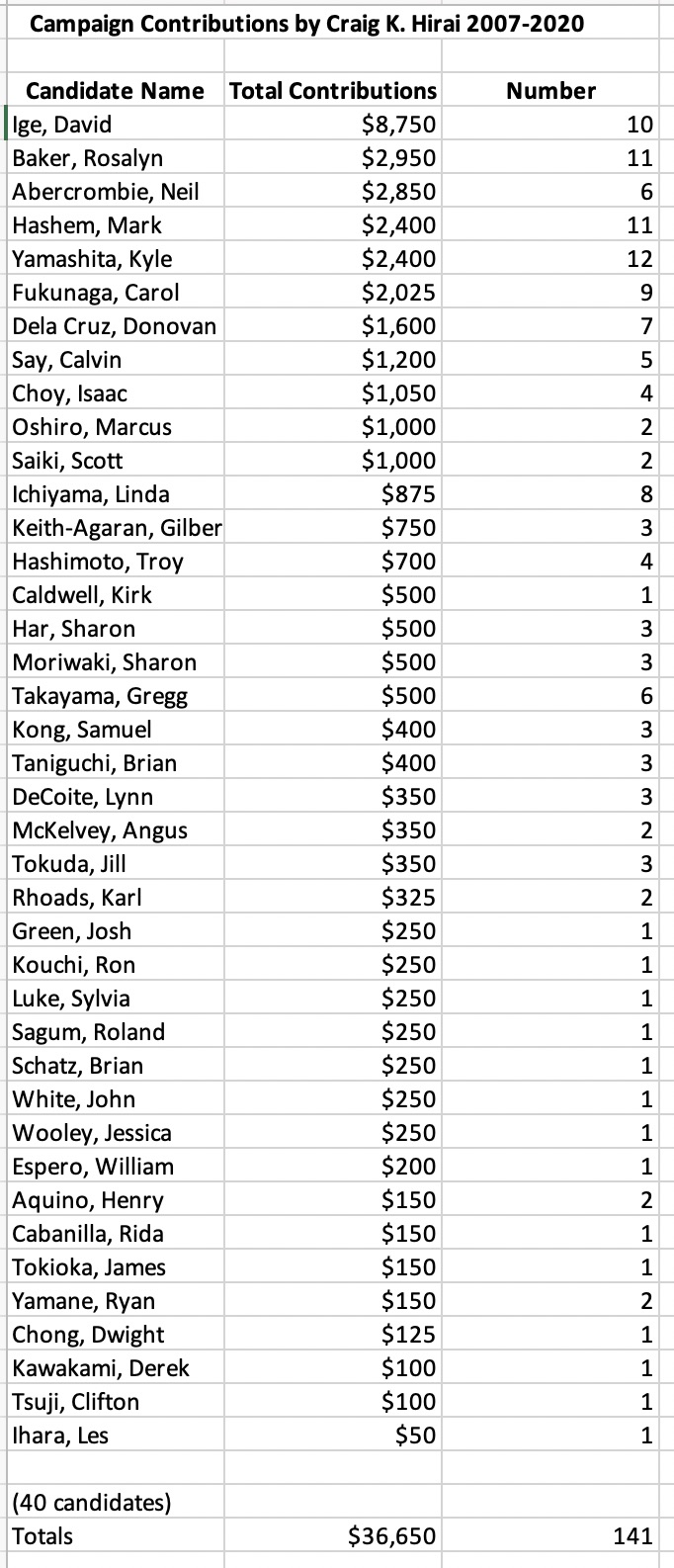
What the committee report doesn’t mention is that Hirai has also been a political player and a frequent contributor to political campaigns. Hirai has contributed a total of $36,650 to candidates between May 2007 and June 30, 2020, mostly Democratic legislative candidates or elected officials.

The majority of Hirai’s contributions were $250 or less, and were spread among 40 different candidates.

Hirai contributed a total of $8,750 to David Ige beginning with $250 in August, 2011, and including six contributions of $1,000 or more between 2014 and 2018.

My guess is that Hirai attended political fundraising events in order to build his networks and stay in touch with legislators and lobbyists. With the exception of his larger contributions to Gov. Ige, none were large enough to indicate that he was attempting to gain special access or influence.

Ethical and legal boundaries

Here’s one of the comments received in response to Saturday’s post:

UPON reading and re-reading the anonymous and unverified comment, I am left asking what the difference is between a “fundraiser” and “political party”?

Is it illegal for a private businessman/citizen to host a party and invite politicos and political groupies?

When does social networking become a crime?

If campaign contributions weren’t made what’s the deal?

In other words, is it a crime if some wealthy person wants to hold a party and invite politicos?

Paragraph two is where the anonymous commentator loses me and contradicts.

If the “political party” were hosted by a prominent businessman, why would that person need the hotel venue, food, and alcohol to be paid for by lobbyists?

But don’t get me wrong. I see the danger of these secret “shindigs” and most likely your anonymous commentator is telling the truth. In this day and age when Hawaii has a huge federal law enforcement presence, local politicos better be careful.

Sounds like a fun party at the Pagoda, wish I could have been there.

Well, I’ll try tackling that from two sides.

Begin with the state’s ethics code. Here’s the provision relating to gifts.

§84-11 Gifts. No legislator or employee shall solicit, accept, or receive, directly or indirectly, any gift, whether in the form of money, service, loan, travel, entertainment, hospitality, thing, or promise, or in any other form, under circumstances in which it can reasonably be inferred that the gift is intended to influence the legislator or employee in the performance of the legislator’s or employee’s official duties or is intended as a reward for any official action on the legislator’s or employee’s part.

So a party–entertainment and/or hospitality–is covered by the ethics code.

An ethics commission “quick guide on gifts” provides further discussion.

The first question is whether you can accept a gift. The State Ethics Commission looks at three factors:

1. Donor. Who is offering the gift to you? What is that person’s relationship to you? If you are directly regulating someone – that is, if you decide whether someone gets a permit, or funding, or a citation – then you generally should not accept anything from that person, regardless of its value. If the person giving the gift is a long-time personal friend who never does business with your state agency, that’s probably okay. This is usually the first question we ask – if the donor relationship creates a problem, we usually don’t even look at the second two factors.

2. Value. How much is the gift worth? Is someone giving you a pencil worth a few cents or a round of golf worth $100? The public should trust you to do your job with integrity; this trust may be lost if people see you taking lavish trips, eating fancy meals, or otherwise enjoying expensive things that are paid for by someone else.

3. State purpose. How will the State benefit if you accept the gift?

Further, the following section of the state ethics law (Section 84-11.5) requires gifts to be public disclosed in an annual report if (a) the gifts from a single source received during the year have an aggregate value “in excess of $200,” (b) the donor of the gifts has “interests that may be affected by official action or lack of action by the legislator or employee,” and (c) the gift or gifts is not otherwise exempt.

In the hypothetical situation described on Saturday, donors included lobbyists, interest groups and organizations that hire lobbyists, as well as those doing business with the state. For that reason, as their “quick guide” advises, “you generally should not accept anything fro that person, regardless of its value.”

I’ve heard elected officials defend taking gifts from lobbyists, saying “I’ve known him/her forever.” I don’t think that’s a defense that will fly.

Then there’s the “fair treatment” provision of the ethics law. Here’s the first part of that provision.

§84-13 Fair treatment. (a) No legislator or employee shall use or attempt to use the legislator’s or employee’s official position to secure or grant unwarranted privileges, exemptions, advantages, contracts, or treatment, for oneself or others; including but not limited to the following:

(1) Seeking other employment or contract for services for oneself by the use or attempted use of the legislator’s or employee’s office or position;

(2) Accepting, receiving, or soliciting compensation or other consideration for the performance of the legislator’s or employee’s official duties or responsibilities except as provided by law….

When you’re invited to a party because you’re a legislator, it could be construed as using your official position to secure unwarranted privileges or treatment not available to the rest of us. Alternately, it might be seen as accepting a gift of hospitality. In either case, it will likely be seen as a problem.

Notice that these ethics provisions apply to public officials and employees, not to those who might organize such events. And laws regulating lobbyists, as well as our campaign spending laws, raise different concerns.

As you can see, it looks like I’ll have to return several times to answer the questions posed in that comment.