Category Archives: Media

A small contribution to a book about Kahoolawe for young readers

In early 2022, I received an email from a woman I didn’t know who had questions about my participation in the first protest landing on the island of Kahoolawe in January 1976.

“I’m working on a middle-grade nonfiction book project on Kaho?olawe, including a chapter on the January 1976 first landing,” longtime Leeward Community College writing prof Kamalani Hurley wrote. “I’m looking for the details and cool/nerdy facts that will make that time — especially before the authorities showed up — more real and relatable for middle grade readers. How cool it must’ve been to be the photographer at this history-making event!”

As often happens, it was lost in my email and over four months passed before I noticed it. I replied, apologizing profusely, wondering whether I had missed the boat. Luckily, that wasn’t the case.

More than a year later, I was contacted by artist and teacher Harinani Orme, who was working on the illustrations for Hurley’s book, and had run into my photos of that 1976 landing and its aftermath posted online.

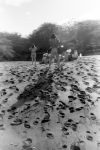
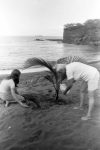
“I would like to ask your permission to be inspired by your photographs as I draw for the book (vague figures, gear on the beach, planted niu on the beach, boat, beach landscape, etc),” she said.

Long story short. Their book was released this year. It’s a gem, and is now available at Da Shop in Kaimuki and local bookstores, as well as via Amazon, Powell’s Books and, perhaps, other online booksellers.

Honolulu Magazine published an interview with Hurley about the Kahoolawe book, which has garnered glowing reviews, several of which are quoted on the author’s website.

The finished book includes a two-page spread describing the 1976 landing. Orme’s illustration is a stylized representation incorporating elements from several of my photos, which I’ve included below.

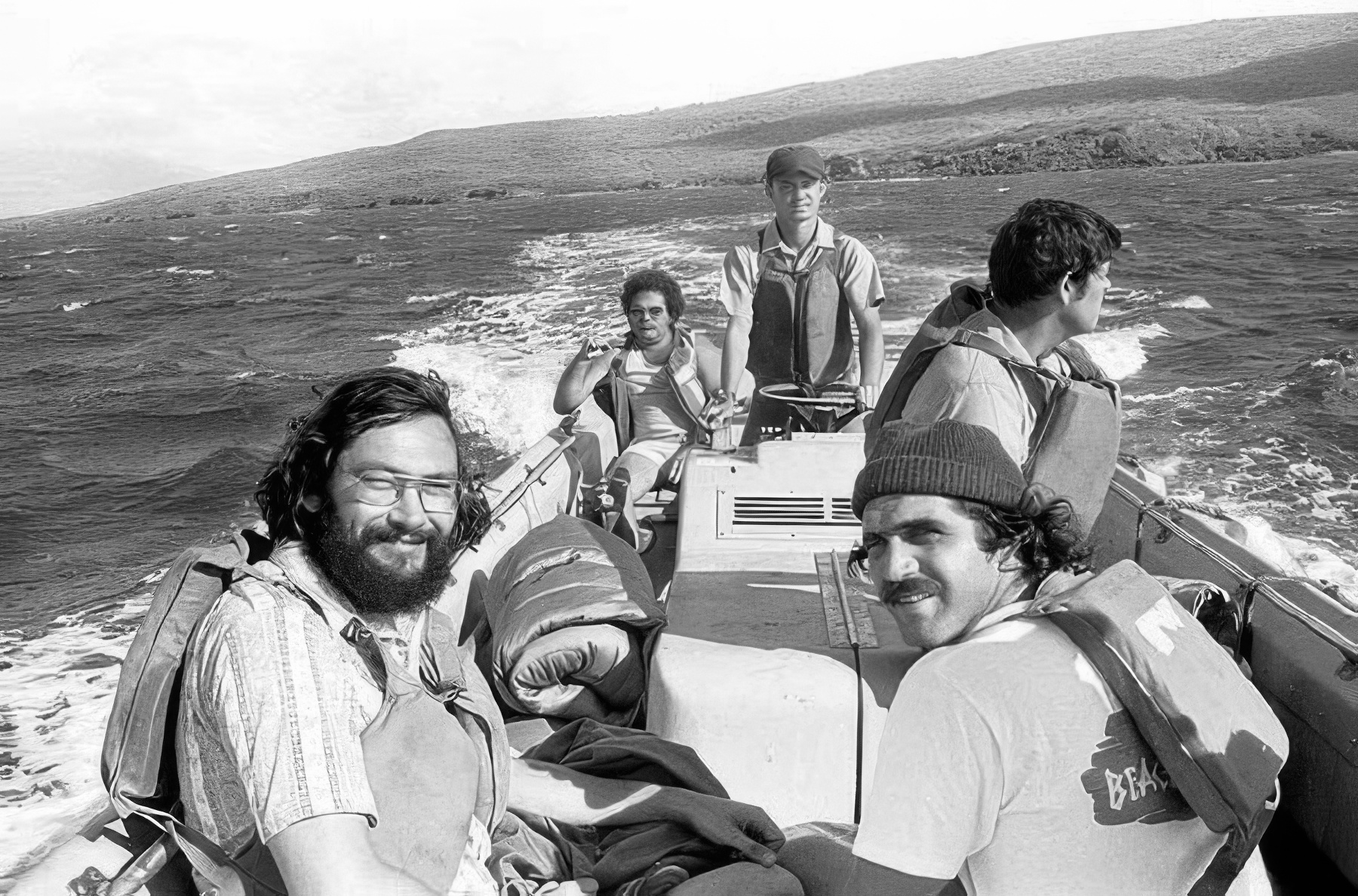
Oh, for the record. Here’s a photo of me, along with Gail Kawapuna Prejean and Steve Morse, as we are being escorted off of Kahoolawe to a Coast Guard ship waiting offshore. Before long, each of us received a letter from the 14th Naval District barring us from returning to Kahoolawe. My framed letter may be the only original in existence after 49 years.
Yikes. Next January will be the 50th anniversary of that first landing.

Oregon county officials blasted for Hawaii junkets

Winter isn’t over here in Portland, with weather still dominated by cold, gray, and wet days. So a report that some area public officials have been flying to Hawaii once or twice a year at public expense on previously undisclosed trips makes for a good headline story!

See: “How Washington County sewer officials scored annual Hawaii trips and 5-star lodging.”

The Oregonian newspaper and OregonLive.com have been skewering the members of Oregon’s Washington County sewer agency for undisclosed annual trips to Hawaii.

At least eight people with ties to Washington County’s sewer agency have traveled to Hawaii for business conferences in recent years, staying at an assortment of five-star resorts across several islands offering breathtaking views of the beach and ocean.

Those trips aren’t accounted for in the agency’s annual budgets even though ratepayers of Clean Water Services indirectly footed the bill.

Three of the group trips to Hawaii cost a whopping $91,000 and, in some instances, government officials received first-class airfare, premium hotel rooms or fine dining, an investigation by The Oregonian/OregonLive has found. Officials made four other trips at an undisclosed cost.

It’s not uncommon for government workers in agencies large and small to attend out-of-state conferences to learn about and keep tabs on industry best practices. But what makes the Hawaiian excursions unusual is their frequency, cost, lack of transparency – and that the recurring tropical location is the result of a local business decision made by design.

Washington County is part of the Portland Metropolitan Area, home to several cities including Beaverton, Hillsboro, and Tigard.

The county’s Clean Water Services department formed its own captive insurance company in 2016, and chose Hawaii as the new insurer’s headquarters due to the state’s captive insurance program that counts more than 270 captive insurance companies on its rolls.

These closely-held insurers are most often set up by corporations. In 2016, the year that the county established its “captive” ih Hawaii, Oregon law reportedly didhot allow “public entity not-for-profit captives,” although there is some dispute over whether that was actually the case.

But by establishing its captive insurance company in Hawaii, the sewer agency was required to hold their annual board meeting in the islands.

The Oregonian reported that Hawaii touts its location as a benefit.

“If you are forced to go to Hawaii once a year to have a board meeting that’s paid for by the company, it’s usually not a bad thing from most people’s perspective,” Ryan Keeling, a financial analyst with Oregon’s Department of Consumer and Business Services, which oversees the state’s own captive insurance program, said wryly.

The story seems to have legs, as they say, and it has appeared in promotional emails by OregonLive throughout the week.

It makes me wonder how many other interesting stories might be found among Hawaii’s 270+ captive insurance companies.

Tariffs on Canadian products to hit newsprint

If Trump’s tariffs on Canadian products goes into effect as threatened, one of the immediate victims will be America newspaper publishers, who are reliant on Canadian newsprint.

According to a recent story in the Columbia Journalism Review:

Canada has long been a major supplier of American newsprint—it now provides an estimated 80 percent of the paper used by US newspapers. A tariff would add a significant burden to publishers already struggling with high costs of production and thin margins, and analysts say the mere looming threat of one has complicated life for printers. “There is no scenario under which this is cost-positive for the media industry,” said Brett House, a professor of professional practice at the Columbia Business School. “Almost anything that is done here is going to be increasing prices for newsprint.”

John Galer, the publisher of the Journal-News in Hillsboro, Illinois, said the new tariffs represent more than just a financial setback. He publishes eight newspapers and prints nineteen other publications at his press, serving rural communities that often have no other dedicated source of news. His publications rely entirely on Canadian newsprint, and he estimates a 25 percent tariff would increase his costs by about twenty thousand dollars a year, forcing him to increase his prices. “I like to stay hopeful,” he said. “But right now, we’re all just waiting to see what happens next.” (Galer learned of the postponement of the tariffs from a text message as we were speaking on the phone. “I don’t get it,” he muttered.)

Trump, who has no love for newspapers and their nosy reporters, may welcome the demise of more newspapers as a result of the increasaed cost of newsprint.

Carpenter Media Group owns the Honolulu Star-Advertiser and MidWeek, as well as newspapers on Kauai and Hawaii Island, which are among about 250 papers the company holds in the U.S. and Canada, many in the southern states of including Texas, Louisiana, Mississippi, North Carolina, Tennessee, Georgia, Virginia and Kentucky.

The impacts are likely to include continuing staff cutbacks across the industy, increases in subscription prices and a resulting decline in print readership. None of this is good news for already struggling newspapers.

Martha Diaz Aszkenazy, chair of the National Newspaper Association, told CJR that the uncertainty has been hitting newspapers even before the tariffs go into effect.

“It’s affecting our customers who are, for instance, holding back from making decisions about advertising,” she said.

“I just don’t know why we are doing this,” she said. “It seems like instead of making America great, we’re just making America scared.”

Facing the current situation

I know that most of our friends are struggling with the question of the moment–What can we do to hold back the takeover of our government by authoritarian fascists (and I don’t use that term lightly)?

I recommend read Sunday’s column by Ben Wittes, a former reporter and Washington Post editoria writer, now editor-in-chief at LawfareMedia.com. “The Situation” is a regular column appearing at Lawfaremedia.com.

In Sunday’s edition, he reviews the litany of areas in which DJT’s administration is wreaking havoc and destroying storied institutions and, worse, political and cultural values.

And then he muses as to whether this is should be seen as akin to an astroid striking the earth, about which nothing can be done except to try to find a safe spot to hunker down and pray for survival, or as “a kind of supernova, a rapidly expanding ball of fire that then collapses in on itself?”

I’m taking the liberty of reprinting the second half of his Sunday’s column, “The Situation: The Full-Scale Situation Two Months In.”

And, while you’re at it, check out earlier editions of “The Situation,” as well as the rest of Lawfare’s research and commentary. I know that you’ll find it rewarding.

Is America in the middle of an asteroid impact on more than two centuries of its democratic government and many—if not quite all—of its works? Or is it instead seeing a kind of supernova, a rapidly expanding ball of fire that then collapses in on itself?

Put in more military terms, is looking at a snapshot of the Full-Scale Situation today like looking at the Mongol or Roman empires during their expansions, which set up whole swathes of the world for centuries of domination? Or is it more like looking at a snapshot of the Napoleonic empire in 1812 or imperial Japan or Nazi Germany’s conquests in 1942 and imagining permanence when the reality would be, while cosmically destructive, altogether short-lived?

I am not going to try to answer this question. I try to avoid predictions.

I will say that the asteroid scenario becomes more likely the more people believe in it. One doesn’t litigate against an asteroid impact, after all. One doesn’t turn out in the streets to push back against asteroid impact. One also doesn’t run for office against the asteroid or its supporters. Rather, one hunkers down in what one imagines to be a safe place, very far away—and very underground—and hopes the worst effects don’t reach you. And one let’s the rest of the world fend for itself.

Conversely, if one believes that one is dealing with a power that looks immense but, in fact, is hyperextended and poised—as the Marxists might say—to collapse under the weight of its own contradictions, one might be inclined to add a few contradictions to the pile: a lawsuit here, maybe, a protest there, a political campaign, perhaps, support for groups that are managing the worst of the maelstrom. One might be inclined to snipe from behind the lines of the overextended empire. One might be inclined to work with allied democratic actors to protect core democratic interests. One might be inclined vocally to oppose invading Canada.

I can’t promise that if we all act like this problem is manageable, it will prove so. But I can promise that if we all act as though this problem is not manageable, it will not be.

So how’s it going two months in? I prefer to answer that question as follows: It’s a gravely dangerous situation; the executive branch is doing a lot of terrible things, and Congress is facilitating the damage it is inflicting. On the other hand, all over the country, inside of government and out, people are standing up for what’s right. They are quitting rather than carry out destructive policies. They are litigating. They are showing up to town halls to demand accountability from legislators. They are raising money. They are helping people who need help. The courts are functioning. Many of the worst policy moves have been stopped, at least temporarily. Many others have been softened or slowed. There is a fight happening. And it’s happening in a thousand places at once, because American democracy is not that fragile, and deconsolidating a democratic culture as rich as this one is a hard project.

Can it be done? And can it be prevented? I assume the answers to both of these questions are affirmative. It can be done, so treat this as a five-alarm fire. But the assumption also has to be that it can be prevented. Americans, after all, are not dinosaurs, and Trump is—metaphors aside—not an asteroid.

There will be damage. The president gets to inflict damage even where he doesn’t prevail—just as a defeated army does.

But don’t confuse the damage that is already visible with success on the part of the authoritarians. That is still a long way off.