Yesterday’s post wrapped up just before 10 a.m. While I was writing and editing it, there were certainly things I failed to note and won’t appear here. But I’ll do my best to put the pieces together here for future reference.
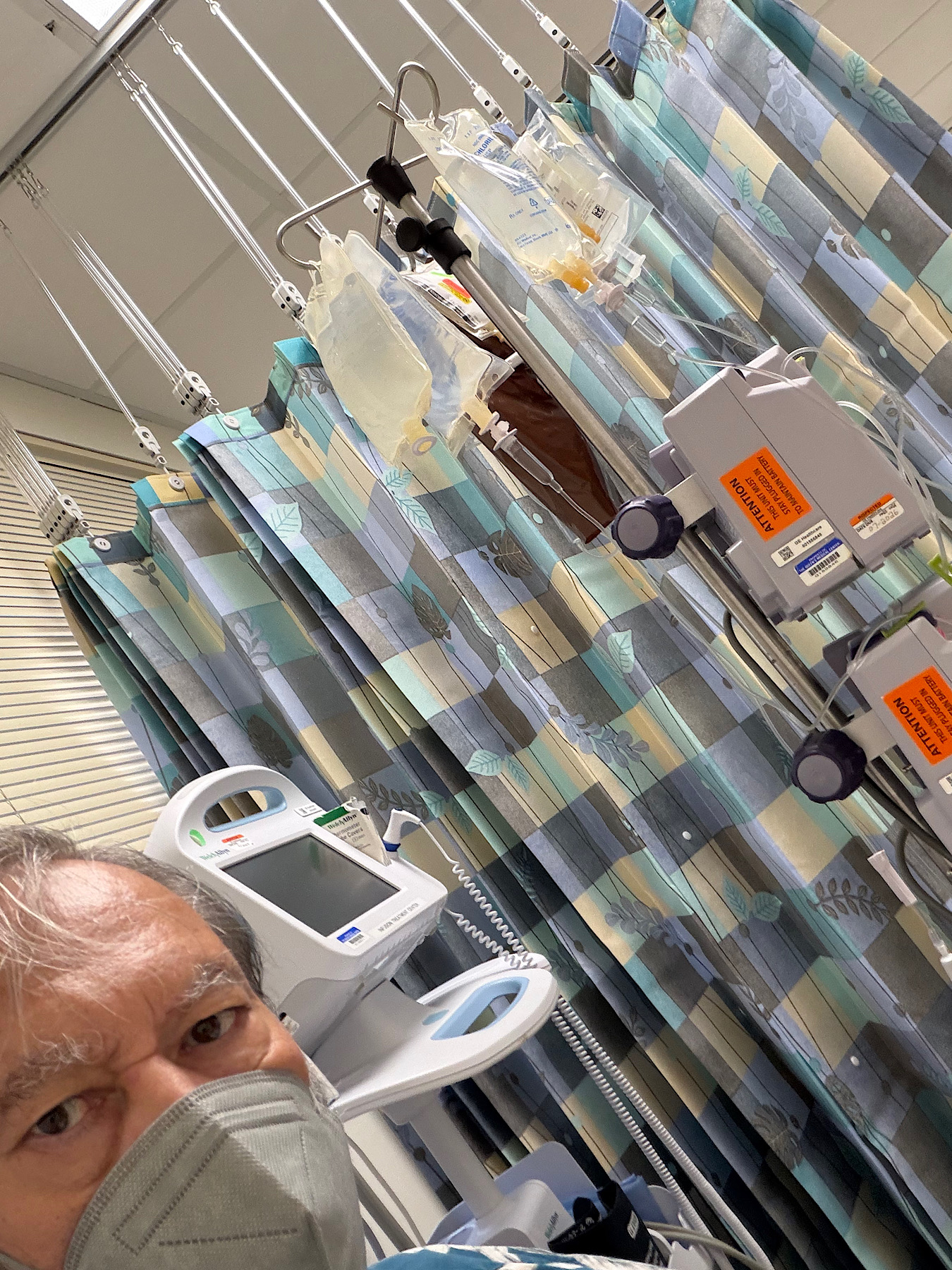
The annoying beep of one of the two controller/monitors on the IV pole next to my chair sounded off, announcing that the bags holding the immunotherapy drug, Durvalumab, had emptied into my veins. Nurse Pattie quickly reappeared and said it would be followed by a 5-minute flush, then on to the next main course.
“This is Cisplatin,” Pattie explained. “It’s the mean one of the bunch.”
She added: “Your lucky you have the port. This one stings when the IV is on your arm.”
Here’s Google’s AI summary of Cisplatin, which it credits info from the National Cancer Institute.
Cisplatin is a platinum-based chemotherapy drug administered intravenously to treat advanced cancers of the bladder, ovaries, and testicles. It works by cross-linking with DNA, causing damage that prevents cancer cells from dividing and surviving.
Many oncologists also use it “off labeL” for treatment of other cancers where available evidence is ahead of FDA reviews and approvals.
I notice that the bag of Cisplatin is covered with another dark opaque bag.
“Light sensitive?” I ask.
Yes, she answers. “But I worked with it for 25 years before I knew that,” she said.
Then, with a wry smile, she pointed to the window, which was covered with a shade to only hint at the sunlight outside. “That’s the light it’s sensitive to,” gesturing toward the outside world. Then, pointing up at the fluorescent light fixtures in the room, “Not this.”
But she shrugged, implying “rules are rules,” rechecked the controller, scanned the code on the Cisplatin bag, and disappeared back to her other patients.
My notes indicate the Cisplatin was finished somewhere around 11:45, followed by another five-minute flush.
Then came the third drug–the part of the chemotherapy regimen–Gemcitabine. My notes show it was estimated to take 30 minutes. After that, there would still be two hours before the infusion was finished and I was ready to leave.
I asked Google’s Gemini how that final couple of hours is used.
When a comprehensive 5-½ hour oncology appointment is scheduled but the primary chemotherapy and immunotherapy active drug infusions wrap up before the final two hours, those final two hours are typically dedicated to a critical medical sequence focused on **safety, hydration, and acute side-effect monitoring**.
The final segment of a long infusion day generally encompasses the following protocols:
1. The Post-Medication Line Flush
Once the active treatment bags are empty, nurses do not simply remove the IV or de-access the port. A significant amount of active drug remains inside the plastic tubing of the administration set.
* **Saline/Dextrose Flush:** A clear bag of compatible fluid (usually normal saline) is run through the lines at a controlled rate. This ensures that every drop of the prescribed chemotherapy or immunotherapy is pushed completely into the bloodstream and doesn’t remain wasted in the tubing.
2. Mandatory Post-Infusion Observation Period
Immunotherapy drugs (such as monoclonal antibodies or checkpoint inhibitors) and certain heavy chemotherapy agents carry a known risk of **delayed hypersensitivity or infusion-related reactions**.
* **Reaction Window:** Even if the active drugs went in smoothly, the body’s immune system can mount a delayed reaction as the drug concentration peaks in the tissues.
* **Monitoring:** Nurses use this window to closely monitor vital signs (blood pressure, heart rate, temperature, and oxygen saturation) and watch for any signs of chills, shaking, fever, skin flushing, rash, or shortness of breath. Having the patient remain in the controlled environment of the chair with active IV access allows the staff to intervene instantly with rescue medications (like IV antihistamines or steroids) if a reaction triggers.
3. Hyper-Hydration and Organ Protection
Many intensive chemotherapy regimens require a substantial volume of post-treatment intravenous fluids to protect the kidneys and bladder.
* **Flushing the Toxins:** The kidneys bear the heavy burden of filtering and excreting cellular debris and chemical byproducts as the drugs begin their work.
* **Preventing Toxicity:** Flooding the system with IV fluids over these final hours forces rapid urine production, preventing the highly concentrated medication from sitting in the bladder or damaging the renal tubules.
4. Disconnect Protocols and Home-Care Briefing
During the final stretch of the session, the clinical team prepares the patient for discharge:
* **Pre-discharge Meds:** Administering long-acting, post-infusion anti-nausea medications or giving instructions for scheduled take-home oral medications.
* **Port/Line Maintenance:** If the patient has a central line or implanted port, it is flushed with a heparin solution (if required by protocol) to prevent blood clots before being safely de-accessed or capped off.
* **Safety Education:** Reviewing the standard **48-to-72-hour home safety precautions** (such as the double-flush toilet protocol to protect family members and pets from trace hazardous waste in bodily fluids).
I reclined my chair, got my travel pillow out of my treasure bag, and took a short nap, which was finally interrupted by a signal from my bladder. I recall it being well into the wind down period, perhaps around 1 pm. I leaned forward to look around the curtain that separated me from the patient next door and the view down to the other end of the room, where nurses had their computer work stations. I called down and Pattie came quickly, commenting that this was my first visit across the hall. I recall her saying something akin to “iron bladder.”
And the last hour slipped by fast. Fluids played out, bags emptied. And then I was done.
I hadn’t used the battery that I brought along for possible device recharging. My iPhone still had about a 50% charge, iPad about the same. And my Kindle, well, the Kindle lasts through a week of reading, so this took little off of its full charge.
Next second infusion session next Monday will take less time. It might shave an hour, perhaps a bit more, out of this initial 5-1/2 hour session.
We’ll see. My next step is a brief checkup on Thursday, and a blood test Friday morning, since the lab closes at noon on July 3, and is closed July 4.