Category Archives: Housing

Hawaii has fallen behind the times in protecting tenants’ rights

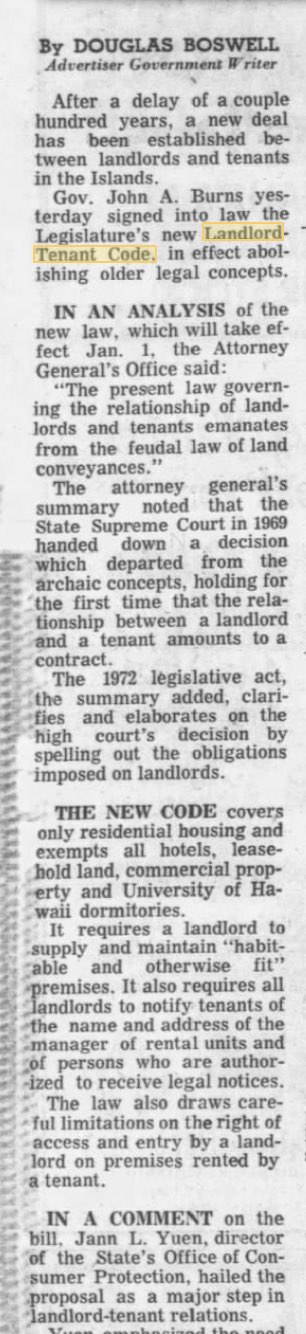
Hawaii’s Landlord-Tenant Code was part of the legislative package put forward by Gov. John Burns in 1970, and it was passed into law by the Legislature in during the 1972 session. It was seen as a major step forward in protecting tenants’ rights.

The Honolulu Advertiser reviewed the law following its passage in a story published May 31, 1972: “After a couple hundred years, a new deal has been established between landlords and tenants in the Islands.”

It was, at the time, a progressive move.

But a decision by the 9th Circuit Court of Appeals issued on Tuesday involving an Oakland law is a pretty stark reminder that Hawaii’s Landlord-Tenant Code has failed to keep up with the times or to address the needs created by the related problems of high housing costs and equally high rates of homelessness.

The 9th Circuit decision came in a lawsuit against the City of Oakland by a couple that was required to pay more than $6,500 to their tenants who were evicted because the owners wanted to move back into their own home. The payment was below the standard set by city ordinance because the tenants had been renting less than two years, which reduced the amount of the payment.

The East Bay edition of The Mercury-News reported:

The lawsuit took aim at Oakland’s Uniform Relocation Ordinance that requires landlords to pay tenants thousands of dollars if they are evicted for no fault of their own, such as making way for the owner or a family member to move in or when an apartment is converted into a condo. Tenants’ rights advocates say the ordinance helps displaced renters afford first and last month’s rent and a security deposit in a new place — and helps prevent them from becoming homeless in the Bay Area’s expensive rental market.

San Francisco, Berkeley and Palo Alto have similar ordinances, but landlords have complained the laws put an unfair burden on homeowners.

Oakland’s ordinance eases the hardship of eviction, particularly for tenants who lose their rent control status and are thrust into a significantly more expensive market, according to Oakland City Attorney Barbara Parker.

Is a law requiring landlords to pay tenants’ “relocation assistance” considered radical?

Do a bit of online searching (“Uniform Residential Tenant Relocation Ordinance”) and you’ll find that the idea of required relocation assistance when tenants are tossed out through no fault of their own seems quite common and well established, although it’s hard to say whether the Oakland law is more onerous for landlords than is the case in other jurisdictions.

Ballinger v. City of Oakland, Decided by the 9th Circuit Court of Appeals 2-1-2022 by Ian Lind on Scribd

The squatters next door

Squatter (noun): One who occupies a building or land without title or permission.
wiktionary.org

There’s a curious back story regarding the residence on Kumukahi Place in Hawaii Kai that alleged crime boss Michael J. Miske, Jr., purchased at a foreclosure auction two years ago, and is now in the process of selling.

On June 6, 2013, James Harold Hall and his family moved into the home, which had been vacant since the death of its owner the previous year, and was in the process of being foreclosed on by the lender. The Hall family became squatters, battling in court to avoid or delay eviction as long as possible. They were finally removed from the property by court order in early 2018.

This wasn’t their first squat.

The story of the Hall family squats is revealed in court filings generated over the course of a long and contentious divorce and related litigation between Hall and his former wife, Tara Marie Hall, as well as records of foreclosure and ejectment lawsuits by the lenders and owners of the properties where they lived without permission.

Prior to moving to Hawaii, Hall owned a construction company in Wisconsin which renovated and flipped houses. 

Hall Development and Construction was caught up in the collapse of the national housing market, and filed for Chapter 7 bankruptcy in October 2008. At the time of the bankruptcy, the company was facing 25 civil lawsuits and listed debts of $17,500,925.39. The family also lost their personal residence through foreclosure. 

The first and last “legitimate” rental 

James and Tara Hall, and their four daughters, moved to Honolulu in January 2009, court records show. Neither  was employed. They initially rented a home at 553 Kumukahi Place in Hawaii Kai.

During the two years the Halls lived at Kumukahi Place, James Hall became friends with their next door neighbor, Cary Thornton, a Honolulu contractor who originally hailed from Utah. 

Thornton, who was attempting to arrange a short sale of his home, gave Hall a power of attorney so that he could help in finding a buyer.

But Hall’s own financial problems soon forced the family to move before a sale could be done. The house on Kumukahi Place turned out to be “the last place the parties legitimately rented,” according to a later statement by Tara Hall filed in the couple’s divorce case.

“In 2011, our cache of money was depleted, consequently we could no longer afford rent at 553 Kumukahi Place,” Tara Hall wrote later in a statement filed in court.

“When money ran out, [James Hall] began this cycle of moving the family into abandoned homes—essentially creating a situation where the family were squatters,” Tara alleged.

Tara said that after leaving Kumukahi Place, her husband moved the family into another empty home he had located on Ehu Wai Place, also in Hawaii Kai. 

Empty house #1: Ehu Wai Place

It was a five-bedroom, three-bath home, with pool and a separate guest quarters, located on the marina in The Anchorage neighborhood of Hawaii Kai, considered one of the prime areas due to its waterfront location.

“[F]rom May 2011 to January 2012, our entire family were squatters in the home until we were finally legally evicted from the residence,” according to one of Tara Hall’s court filings.

Before the family moved themselves into the home, the owners of the Ehu Wai property had been hit with a foreclosure lawsuit by their mortgage holder, Chevy Chase Bank FSB. The lawsuit, which was filed  in July 2009, dragged on in court for over a year, but in August 2010, the  bank obtained a default judgement against the owners and was granted an interlocutory decree of foreclosure, court records show.

The home was sold at a foreclosure auction held on November 3, 2010, outside of First Circuit Court in Honolulu. Capitol One NA, which had acquired Chevy Chase Bank the year before, was the winning bidder. No other bidders appeared later to challenge the bank, and the commissioner’s sale was confirmed in court on January 6, 2011. The final order approving the sale, along with attorneys fees and costs, and a deficiency judgement, had been issued by Judge Bert Ayabe on April 7, 2011. 

The Halls moved in the following month. 

On January 17, 2012, about eight months after they occupied the home, three plain clothes police officers came to the door to serve a writ of possession signed by Judge Ayabe. The writ authorized the officers to “remove any and all persons occupying the above premises pursuant to this writ of possession, effective forthwith, including their personal belongings and property,” court records show.

Hall, who had taken paralegal classes at Kapiolani Community College, filed a pro se  lawsuit against the bank on the same day in an attempt to block the eviction, alleging it would violate tenants’ rights provided under federal law. The lawsuit asked the court to award  upwards of $95,000, including damages, costs, and fees.

Although the lawsuit went forward, Hall’s request for an emergency injunction to block eviction was denied, and the family was ejected from the property on February 1, according to documents filed later in court. Despite failing to halt the eviction, the family had managed to live in the home for about more than half a year, apparently without paying rent.

During a subsequent hearing on Hall’s lawsuit before Judge Rhonda Nishimura on June 21, 2012, months after the family was evicted, Hall claimed to have signed a rental contract before the family had moved into the house. Hall said he had agreed to do repairs and maintenance to make the house habitable, apparently in lieu of what he claimed was an agreed on rent of $1,925 per month. 

However, Hall did not produce a copy of a lease or any other documentation, and the lawyer representing the bank denied the existence of any landlord-tenant relationship with Hall. His lawsuit was dismissed “with prejudice,” meaning that it could not be refiled.

Hall appealed the decision to the Intermediate Court of Appeals. His appeal was dismissed the following year.

Empty House #2: Polihale Place

Meanwhile, after the family was evicted from the Ehu Wai house, Hall then “found another empty home in Portlock…where we squatted from January 2012 through June 2013,” according to Tara Hall’s account.

This time it was a 4-bedroom, 4-bath home on Polihale Place in the Koko Kai Triangle, which had last sold  in 2007 for $1.5 million.

The property owner filed a complaint in court on May 28, 2013 to throw the Hall family out of the home. This time around, Hall didn’t show up in court and lost the case by default. It took a while, but the family was evicted again.

Empty House #3:  Back at Kumukahi Place

In January 2012, about the same time the Hall family was being evicted from the house at Ehu Wai Place, Bank of America filed a foreclosure lawsuit against Hall’s friend and former neighbor on Kumukahi Place, Cary Thornton. 

Seven months later, ill and facing imminent foreclosure, Thornton took his own life. After Thornton’s funeral, his son and daughter sold the home’s furnishings, Thornton’s car and truck, and other personal effects.

In February 2013, after learning that the bank’s foreclosure of Thornton’s home was quickly moving toward a forced foreclosure auction, Hall attempted to intervene in the ongoing case, claiming to be Thornton’s “personal representative.” As evidence, he pointed to the power of attorney from Thornton a couple of years earlier as evidence he was an “interested party” with the right to be included in the proceedings. 

The judge in the foreclosure case sidestepped the question, and referred the matter to the probate court to sort out Hall’s claim to have a recognizable interest in Thornton’s estate. 

By this time, Tara Hall had enough. She moved out and filed for divorce on May 15, 2013.

Then, on June 6, 2013, after the foreclosure case was put on hold pending a ruling in probate court, Hall and three daughters moved into Thornton’s now vacant house.  Hall claimed they moved in to protect the empty house, and said Thornton had wanted to leave it to him in his will.

In the probate court, Hall submitted a declaration saying that after Thornton’s death, the coroner had given Thornton’s daughter, Tara Shook, a sealed package which was then opened in Hall’s presence. 

Hall said its contents “included Cary’s will and a note from Cary referencing his inclusion of me in his Will regarding his Hawaii Kai home.”

That note was evidence that he had an interest in Thornton’s estate, Hall argued. However, his declaration failed to convince the judge, and his request to be among those with an interest in Thornton’s house, and his estate as a whole, was denied.

And, in turn, his attempt to legally intervene to stop the bank’s foreclosure was also denied once his claim to have a legally recognized interest in the case had been rejected.

After Hall’s cases were dismissed in court, both decisions were appealed to the Intermediate Court of Appeals. This time around, Hall didn’t argue the case pro se, without the benefit of an attorney. Instead, he was represented in both appeals by Honolulu attorney Gary Victor Dubin and Fred Arensmeyer of the Dubin Law Office.

The Intermediate Court first dismissed Hall’s claim to have an interest in Thornton’s estate. In its ruling, the court found Hall had no “familial relationship” to Thornton, had failed to produce sufficient evidence of any interest, and what the court referred to as his “unauthorized occupation” of the home, along with his claims to have spent a substantial sum maintaining the property, did not provide the basis for validating his claim to an interest in the estate.

The court also dismissed Hall’s attempt to intervene in the foreclosure and challenge the appointment of a special administrator to conduct the foreclosure auction. The court rejected his attorneys’ generalized claims about the “pernicious and dishonest practice” of banks in pursuing foreclosures, and found their accusation that the special administrator had mismanaged Thornton’s estate “unsupported” by evidence. 

The Thornton home was sold at a commissioner’s auction on March 18, 2018. The winning bid of $1.4 million was submitted by  Kaulana Freitas. After the bid was confirmed, Freitas disclosed he was representing Michael J. Miske, Jr., who then took Freitas’ place in the sale. The sale was final, and a commissioner’s deed issued, on December 31, 2019.

In July 2020, Miske, Freitas, and nine other co-defendants were indicted on federal charges of being members or associates of a racketeering organization controlled and directed by Miske.

Attorney Gary Dubin was disbarred by order of the Hawaii Supreme Court effective November 9, 2020, after the court found he had engaged in conduct involving dishonesty, fraud, deceit or misrepresentation in several cases. His representation of Hall was not among the cases considered by the court. Dubin was then disbarred from practicing in Hawaii’s Federal District Court by order dated September 30, 2021  following reciprocal discipline proceedings. He has repeatedly denied any wrongdoing, blames a cabal of lenders and foreclosure lawyers, and is currently pursuing multiple appeals of both disbarment actions in the 9th Circuit Court of Appeals.

And there’s more to this story.

Stay tuned.

The hotel next door

I’ve been frustrated for the past week, finding lots of “dots” without being able to figure out what the picture will look like when the dots are finally connected.

Here’s an example.

You may recall that back in April, police officers responding to a 911 call shot and killed a 29-year old from South Africa, Lindani Myeni, outside a home at 91 Coelho Way in lower Nuuanu.

It still isn’t clear what Myeni was doing at the home, or why he attacked the responding officers.

State real property records show the current registered owner of the property is James H. Hall, a former contractor who moved to Hawaii from Wisconsin with his wife and four children at the beginning of 2009, after his business had gone bankrupt and their home was lost through foreclosure.

Records show Hall purchased Greentree Properties LLC, a Nevada company that held title to the Coelho Way property, in September 2018 from Honolulu attorney Gary Dubin, who has since been disbarred by the Hawaii Supreme Court. Three months later, Hall transferred title in the property from Greentree to himself.

A week after the fatal shooting, the Honolulu Star-Advertiser reported the home had previously been the subject of complaints about illegal short-term rentals.

In 2019 and 2020 the city Department of Planning and Permitting investigated seven complaints that 91 Coelho Way was being used as an illegal short-term rental. Rentals of fewer than 30 days are not allowed at the property, said DPP spokesman Curtis Lum.

In addition, according to the Star-Advertiser, police officers also responded to several other incidents at the home, including a car break-in, a possible COVID violation, a car accident, and a “miscellaneous incident.”

However, the complaints led to a dead end.

“Our investigation determined that the ads were for 30 days or more, which is not a violation,” Lum told Star-Advertiser reporter Peter Boylan. “On-site inspections of the property did not reveal an illegal short-term rental on this property.”

End of story? Apparently not.

What wasn’t known at the time is that the Hall applied for and received received four federal Payroll Protection Program loans during 2020 and 2021 that totaled over $215,000, including two that classed his businesses as operating a hotel or motel.

In each year, separate loans went to Greentree Properties LLC, the Nevada company owned by Hall since 2018, and to a sole proprietorship also owned by Hall, PPP loan records show.

All four loans were made by First National Bank Texas. These were the only PPP loans made by the bank in Hawaii.

Greentree received a PPP loan of $96,656 in 2021. Greentree’s loan application was approved on April 9, just two days before Myeni’s shooting. Despite applying for and receiving the PPP loan, based on a prior year’s payroll, Greentree Properties is not listed among companies registered to do business in Hawaii, state business registration records show.

Hall’s sole proprietorship received $29,165 in 2021, according to the PPP lookup at the website, FederalPay.org. Both company’s applications reported they were in an industry category for “Hotels (except Casino Hotels) and Motels.”

According to the North American Industry Classification System (NAICS):

This industry comprises establishments primarily engaged in providing short-term lodging in facilities known as hotels, motor hotels, resort hotels, and motels. The establishments in this industry may offer food and beverage services, recreational services, conference rooms, convention services, laundry services, parking, and other services.

FederalPay.org examined loan eligibility criteria, and estimated the annual payroll of $464,000 was required to qualify for the loan awarded to Greentree Properties in 2021.

The size of company’s PPP loan indicates that the number of employees on payroll during the eligibility calculation period (typically 2019) was higher than the 4 jobs reported as retained on the PPP application3. This could be caused by a reduction in employment since 2019, due to Coronavirus or other factors.

The minimum number of employees this company must have had in 2019 to qualify for the loan range received is 5. This estimation is accurate if all employees were paid at or over the $100k PPP salary eligibility cap….

Based on the standard PPP eligibility formula, it may be possible to estimate the payroll expenses represented by a company on their PPP application (see details above). In order to qualify for the PPP loan amount received, Greentree Properties LLC’s 2019 payroll expenses are estimated to be at least $463,949 (not accounting for salary amounts > $100k).

In the earlier round of PPP loans distributed in 2020, Hall received a loan of $20,800, while Greentree received a loan of $69,000. Both companies listed themselves in a different category, this one defined as “other services to buildings and dwellings.”

“This industry comprises establishments primarily engaged in providing services to buildings and dwellings (except exterminating and pest control; janitorial; landscaping care and maintenance; and carpet and upholstery cleaning),” according to the NAICS definition.

Examples of the types of services in this category include building exterior cleaning services (except sandblasting, window cleaning), swimming pool cleaning and maintenance services, chimney cleaning services, ventilation duct cleaning services, and drain or gutter cleaning services.

Greentree Properties LLC, a Nevada limited liability company, had been established in 2007 by former Honolulu attorney Gary Victor Dubin to hold title to the Coelho Way property. Dubin had sole control of Greentree from 2007 until September 2018, when he reportedly sold his interest in the company to Hall, court records show.

Then on November 26, 2018, Hall, now acting as the sole member of Greentree, executed a quit-claim deed transferring title to the Coelho Way property from the company to himself personally. Honolulu real property records now list Hall as the property’s sole owner.

Phasing out single family zoning?

Many of us learned when growing up that the “best” way to live would be in a single family residential neighborhood, where other types of residences, duplexes, townhomes, apartment buildings, etc. are excluded. That ideal of a those nice, private boxes, each with a family separate from the rest, has been with us for a century. But the loss of natural spaces and rural areas to seemingly inevitable and unstoppable urban and suburban sprawl, and the automobile-dependent commutes from home to work and back, took the luster off the dream. And then came the nationwide housing crisis and epidemic of homelessness.

And now single family exclusionary zoning seems on the verge of becoming a thing of the past.

Minneapolis passed a new zoning law three years ago which permits duplexes and triplexes thoughout the city and, like Honolulu, higher density along transit lines.

Wikipedia reports:

In January 2021, Sacramento voted to permit up to four housing units on all residential lots to help the city reduce its housing shortage and to achieve equity goals by making neighborhoods with good schools accessible to people who cannot afford to purchase homes there.

In February 2021, the City Council of Berkeley, California voted unanimously to allow fourplexes in all neighborhoods, with Vice Mayor Lori Droste saying that this is “necessary as a first step in undoing a history of racist housing policies.”

And earlier this month, California Gov. Gavin Newsom signed a bill that effectively eliminates single-family zoning throughout the State of California. Even before that bill was signed into law, cities were breaking with the past.

A 2019 Oregon law “allows duplexes, triplexes, fourplexes, and cottage clusters (which are several smaller homes built around a community backyard or other green space) to be built on land zoned for single family homes in cities with over 25,000 residents,” again according to a Wikipedia summary.

Honolulu has experimented. Ohana Zoning was going to create more housing units. That doesn’t appear to have actually happened. And transit-oriented development reminded us that allowing increased density doesn’t necessarily mean more affordable housing.

On the other hand, we have been living through an unacknowledged experiment in allowing single family zoning to quietly fade away. We are now a city of housing scofflaws, where many–perhaps a majority–of those who own single family homes have worked around city zoning restrictions to create additional rental units. When we moved to Kaaawa in 1988, most of the homes were built on large single family lots. By the time we moved back to town in 2015, many of those large lots had been turned into condominiums that allowed multiple units. Many others just put up interior walls and added a kitchen or bath to create a rental unit. And, of course, everyone knows that as long as your rental doesn’t have all three of the necessities (sink, refrigerator, stove) then it is a legal room rental. Thus, some units offer a refrigerator, sink, and hot plate/toaster oven that can be easily removed temporarily if necessary. Parking becomes an issue, and to some extent traffic, and in some areas, sewage capacity could likely become an issue.

However, it’s an experiment that has largely worked and is a commonly accepted, if not legal way to increase the availability of housing.

Whether formally ending single family zoning would change anything isn’t clear to me. Few homeowners can afford to build multiple units on their property, so it could end up being a boon for speculators and developers, and could result in denser but gentrified neighborhoods instead of increasing the availability of affordable homes and rents.

I supposed much rests on how this new law plays out in California in practive, rather than theory.