Category Archives: Sunshine

State moving to new public access data portal

Back in October 2012, the State of Hawaii launched a new website, data.hawaii.gov, which was described at the time as “an important new tool that will help to transform government and increase public accessibility to public records.”

It was part of Governor Neil Abercrombie’s attempt to upgrade the state’s technology infrastructure in a way that would increase public access to government data by gathering it in a central online portal.

It was run by Socrata, which had also been selected for the federal government’s data.gov website offering access to datasets from federal agencies.

Now the state’s contract with Socrata is due to expire in August, and the officially launched a new data portal last month on a platform developed by a Socrata competitor, OpenGov. The new portal can be found at opendata.hawaii.gov.

At least one agency has run into an apparently unexpected technical glitch that has created a new problem.

The Hawaii State Ethics Commission processes thousands of public filings each year, including annual financial disclosure and gift disclosure forms filed by state employees and public officials, along with lobbyist registrations and disclosure of lobbyist expenditures. Although some of these financial disclosures are confidential, many others are meant to be publicly accessible for inspection.

Until recently, its lists of disclosures were available for viewing and downloading via the state’s data portal. This provided the public with the ability to ask and answer more complex or focused questions. Rather than simply being able to view the expenditures disclosed during a particular year by a particular organization’s lobbyists, it was simple to download the data and look at trends over a period of years. I used the data to rank organizations by the amounts they spend on lobbying, and update those lists over different time periods.

But when the latest deadline for lobbyist disclosures passed, I discovered the data is no longer available for downloads.

So I sent a query to the commission, and received a prompt reply from Executive Director Dan Gluck.

From what I understand, we used to have all our data in Socrata, which you could download, but we’ve been migrating everything over to Salesforce. Our new e-filing system uses Salesforce, so this way, people file their forms (in Salesforce) and then they’re available on-line without us having to tinker with them too much. We’ve also been migrating our old data into Salesforce so that everything’s in one place. The downside is that I don’t think that you can download the data on the public side like you could with Socrata….

The remaining Socrata datasets will be taken off-line in August, I think, so if you’re interested in that data, you may want to download that now.”

Gluck also said the commission staff can download the datasets into Excel or CSV files on request, so hopefully this will at least retain the same level of accessibility that has existed in recent years.

In any case, I immediately contacted the Campaign Spending Commission, and was relieved to find out campaign-related data will continue to be readily accessible going forward.

According to an email from Tony Baldomero, the commission’s associate executive director, “our datasets will still be available to you and the public for download. There’s no change to this in the horizon.”

“The Commission’s candidate and noncandidate committee datasets which you can access on data.hawaii.gov can already be found on opendata.hawaii.gov for you to access,” Baldomero said in an email. “We will continue to have our datasets on both open data sites until data.hawaii.gov is phased out by the State or until our separate contract with Socrata ends.”

See also:

Browsing the State Ethic Commission’s online disclosure system,” iLind.net, July 3, 2019.
Next Monday (June 1) is the “new” deadline for lobbyist disclosures

Governor David Ige’s adinistration and the Hawaii State Legislature have been considering exactly how to restart and redirect Hawaii’s economic recovery.

Whatever decisions are made, there are likely to be winners and losers.

Do you suppose Hawaii’s professional lobbyists have been standing down during this health crisis, since they recognize their special interests, or those of their clients, are far less important than the overall public interest at times like this?

Nah.

Seriously, I doubt lobbyists have curtailed their efforts during the crisis. After all, there are lots of behind the scenes discussions, and are likely to be relatively hasty decisions made that involve an awful lot of public money. That spells opportunities for some of those special interests.

Our problem right now is that we know even less than usual about what lobbyists have been up over the past few months.

Next Monday, June 1, is the deadline for registered lobbyists, and organizations that employ lobbyists, to disclose what they’ve been spending to influence public policy.

It’s the normal due date for disclosure reports covering lobbying activities during March and April. In a normal year, this would include all but the final few days of the legislative session.

This year, it is also the deadline to report lobbying expenditures during the earlier January-February period, because the State Ethics Commission voted to extend the usual March 31 disclosure deadline, first to April 30, and then again to June 1.

It appears the delay in the disclosure of money spent by lobbyists and their clients to influence public policy decisions is another of the less-than-obvious impacts of the coronavirus.

At the commission’s regular meeting on March 27, 2020, the five members voted unanimously to approve an order resetting the disclosure deadline. The order states that the commission found “good cause” to extend the reporting deadline “[g]iven the threats posed by COVID-19, and given the directives from many employers for employees to work remotely….”

However, no further details concerning the basis of the “good cause” determination appear in either the meeting minutes or in the meeting materials that were available with the meeting notice and agenda.

Neither is there any discussion of the authority for the commission’s action. Lobbyist reporting deadlines are set by statute, and the relevant statute–Chapter 97 HRS–requires disclosures for the period from January 1 through February 28 to be submitted by March 31.

The law requires these reports to disclose the amounts spent on items related to lobbying, including preparation of lobbying materials, advertising, gifts, entertainment and events, receptions, meals, food & beverages, and compensation to lobbyists.

While Governor David Ige did suspend a number of laws, including the state’s sunshine law, in a suplemental emergency proclamation issued on March 16, 2020, However, neither the state ethics law (Chapter 84 HRS) nor the lobbyist law (Chapter 97 HRS) were among the statutes that were temporarily suspended.

In the normal scheme of things, boards and commissions have to operate within the constraints of the law. It would be useful for the commission to provide a more complete public explanation of the legal basis for overriding the deadline provided by law.

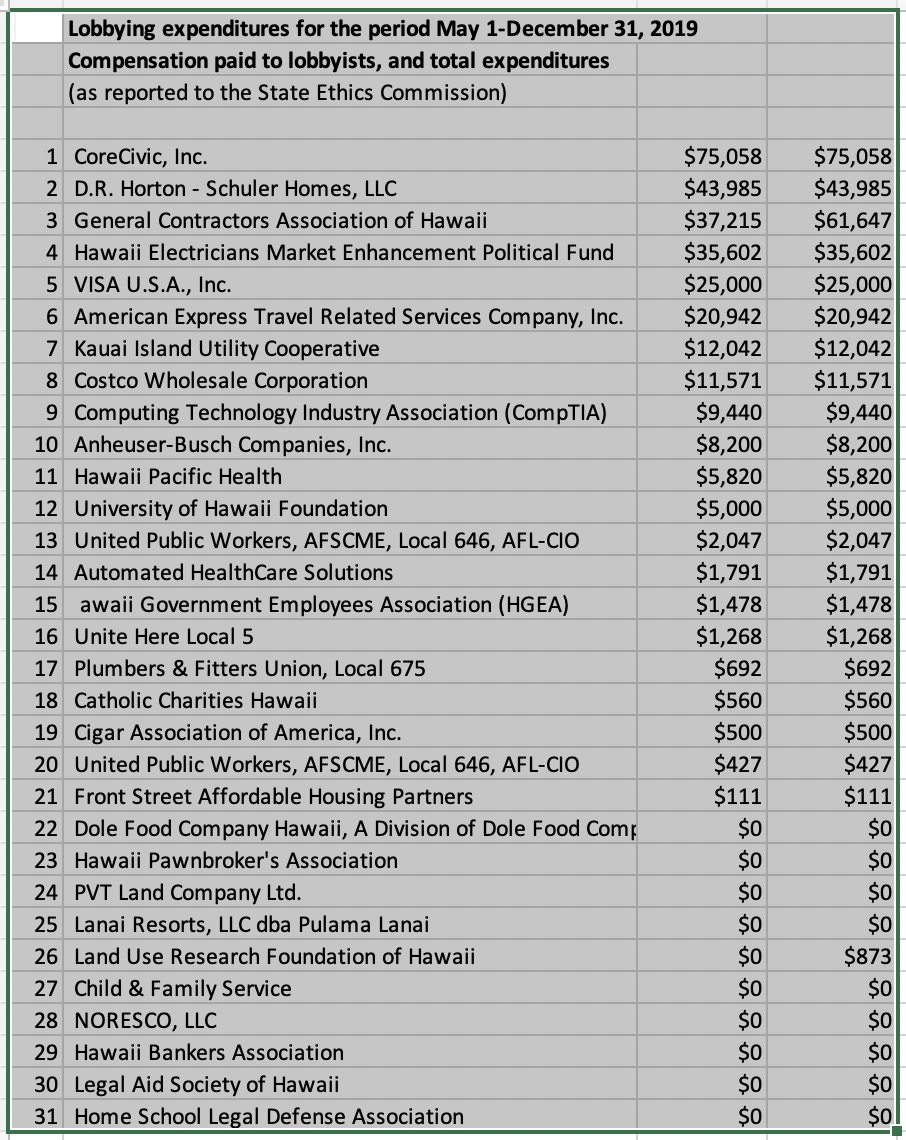
Currently, the most recent lobbyist disclosure reports were for the period May 1, 2019 through December 31,2019. The following organizations disclosed lobbying expenditures during the period.

In case you’re wondering about the company at the top of the spending list, CoreCivic. It’s a private prison operator formerly known as Corrections Corporation of America.

What part of “sunshine” does the Honolulu City Council not understand?

The Honolulu City Council repeatedly violated the state’s open meeting laws when adding items at the last minute to its published meeting agendas, according to a newly released opinion by the Office of Information Practices.

OIP examined four different matters that were added to council or committee agendas, and in each case determined the council violated the Sunshine Law by voting to consider them without prior public notice.

The first matter considered by OIP involved a “gift” from a company controlled by Honolulu businessman Michael Miske of equipment and services that would allow him to string holiday lights on a tree in a city park along the ocean in Hawaii Kai. Both the proposal and its sponsor were controversial, but the council added the matter to its agenda near the end of a meeting that had already gone on for nearly five hours. OIP concluded the action violated the Sunshine Law’s requirement that the public be given sufficient advance notice of matters to be considered in any public meeting.

The purpose of the state’s Sunshine Law, Chapter 92 HRS, is to protect the public’s “Right to know.” It requires public boards and commissions, including the county councils, provide written public notice six-days in advance of any meeting, including an agenda that lists all items in sufficient detail for the public to know what is going to be discussed.

The Sunshine Law provides, in part:

“No board shall change the agenda, less than six calendar days prior to the meeting, by adding items thereto without a two-thirds recorded vote of all members to which the board is entitled; provided that no item shall be added to the agenda if it is of reasonably major importance and action thereon by the board will affect a significant number of persons. Items of reasonably major importance not decided at a scheduled meeting shall be considered only at a meeting continued to a reasonable day and time.”

All too often, this council has given only lip service to sunshine and the public’s right to know, then allowing key matters to be considered without advance public notice.

The first case, and the one which the OIP decision gives the most space to, involves the city council’s meeting on November 1, 2017, when its agenda was amended to add a resolution calling for the gift of equipment and services (valued alternately at $58,000 and $40,000) necessary to add lights to a tree in Joe Lukela Park along the shore in Hawaii Kai as a memorial to Miske’s son, who had died as a result of injuries received in an automobile accident.

The proposal was controversial for several reasons. Miske had installed the same lights illegally the year before, and parks officials had ordered them to be removed. The matter had generated a lot of discussion and debate at the neighborhood level. Allowing private individuals to create “memorials” by adorning city trees on city property was opposed by the Parks Department and some civic groups. And questions were raised about why the city council, led by then-Councilmember Trevor Ozawa, who represented the district, appeared to be giving special treatment to Mike Miske, who had a violent past, a criminal record, and who was facing a trial on felony charges stemming from an assault outside a Honolulu nightclub that he was manager and part-owner of.

According to records of the council’s November 1, 2017 meeting cited in the OIP decision, council vice-chair Ikaika Anderson made the motion to add the Miske resolution to the agenda. His motion was quickly seconded by Kymberly Pine, now a candidate for Honolulu Mayor. Given OIP’s ruling and the Sunshine Law implications, Pine should be asked to address her role and her views of the Sunshine Law.

After all, the four matters addressed by this OIP opinion are only a few of the many instances of this city council’s routine bending of the law in order to address important matters without public notice.

In a Civil Beat column in October 2019, community advocate and former Hawaii Kai Neighborhood Board chair, Natalie Iwasa, called out the council on its sleight-of-hand maneuvers.

The Kealoha case. TMT. Gift of a lighted tree. Appointees to the Hawaii Community Development Authority. Zoo sponsorships. Bike rentals. Antennas on city streetlight poles.

What do these seemingly unrelated issues have in common?

They were all “sunshined” on to Honolulu City Council meeting agendas, so that council members could discuss them without giving proper notice to the public.

The OIP opinion notes that “any person” may “file a lawsuit to require compliance with or to prevent a violation of the Sunshine Law or to determine the applicability of the Sunshine Law to discussions or decisions of a government board.” In addition, any final action taken in violation of the open meeting and notice requirements of the Sunshine Law “may be voided by the court.”

Unfortunately, any suit to void an action has to be filed within 90 days. This OIP ruling comes well over two years since the council’s actions.

See:

Ian Lind: Why A Tree In Hawaii Kai Is Raising Questions Of Favoritism,” Civil Beat, November 27, 2017.

Ian Lind: Playing Hardball Paid Off For Hawaii Kai Tree Lights“, Civil Beat, March 23, 2018.

Man was facing felony charges when aided by Katherine Kealoha,” Ian Lind, iLind.net, March 4, 2019.

Kealoha not alone in doing special favors for local businessman,” Ian Lind, Civil Beat, March 6, 2019.

When The Honolulu City Council Is Less Than Transparent,” Natalie Iwasa, Civil Beat, October 7, 2019.

Honolulu Council Rebuked Again For Violating Open Meetings Law,” Christina Jedra, Civil Beat, May 15, 2020.

Intermediate Court upholds limits on state/county liability for ocean injuries

Every week or so I take a look at the new appellate decisions issued by the Hawaii Supreme Court and Intermediate Court of Appeals looking for interesting cases. This time around, one caught my eye because it dealt with the limits on state or county liability when someone is injured in the ocean. And then, when I tried to review the court records which are routinely available online, I discovered the case is listed as “confidential” and the documents not available to the public.

While skimming through recent decisions last weekend, I noticed a recent Intermediate Court decision worth checking out. The case involves a local man who was injured while swimming at Shipwreck Beach in Poipu, Kauai, fronting the Grand Hyatt Kauai Resort in November 2011. He was caught by a wave and hit his head on a rock, causing serious injuries. He “became a quadriplegic as a result,” the court’s decision said.

Shipwreck Beach Park, next to the hotel, is a county park. Signs posted at the makai end of the park’s parking lot warn of a dangerous shorebreak and strong currents. However, it seems the victim got to the beach from the hotel property, not the parking lot at the park.

A lawsuit was filed in 2013 on behalf of the man and his family seeking damages from the state, Kauai county, and three private entities, including the Grand Hyatt. The lawsuit apparently alleged the signage was inadequate and the state/county were negligent in their warning of the extremely dangerous ocean conditions. Lawyers for the plaintiffs argued the signs should have been two-sided to be more visible from different directions.

Both the state and county were able to win dismissal of the lawsuit, and the private parties settled before trial.

The family then appealed to the Intermediate Court seeking to overturn the dismissal of the state and county. The court upheld the the dismissals in a decision issued May 8, 2020.

The Intermediate Court found the state and counties have a duty to warn the public about dangerous shorebeak or strong currents in the ocean adjacent to any public beach park “if these conditions are extremely dangerous, typical for the specific beach, and if they pose a risk of serious injury or death.”

However, the court upheld the dismissal of the case against the state because there is no state beach park at Shipwreck Beach, and as a result the state has no duty to provide warnings.

In the case of Kauai County, the court pointed to a law passed in 2010 limiting state and county liability (Section 663-1.56 HRS).

This statute provides warning signs are “conclusively presumed to be legally adequate” if they have been approved by the chair of the board of land and natural resources based on consultations with the governor’s task fore on beach and water safety concerning the design and placement of the signs.

Further, the law provides: “Neither the State nor a county shall have a duty to warn on beach accesses, coastal accesses, or in areas that are not public beach parks of dangerous natural conditions in the ocean,” and, further, “Neither the State nor any county shall have a duty to warn of dangerous natural conditions in the ocean other than as provided in this section,” which is limited to dangerous currents and shorebreaks.

The Intermediate Court concluded that the case against Kauai County had been properly dismissed because the record including documents showing the signs had been approved as required by the law and, therefore, “conclusively presumed to be legally adequate.”

Okay, I found the discussion of the limits of the state and counties duty to warn of dangerous conditions quite interesting, and wanted to look at additional legal documents filed in the case. These are available to the public (for a feee) via the Judiciary’s eCourt Kokua system.

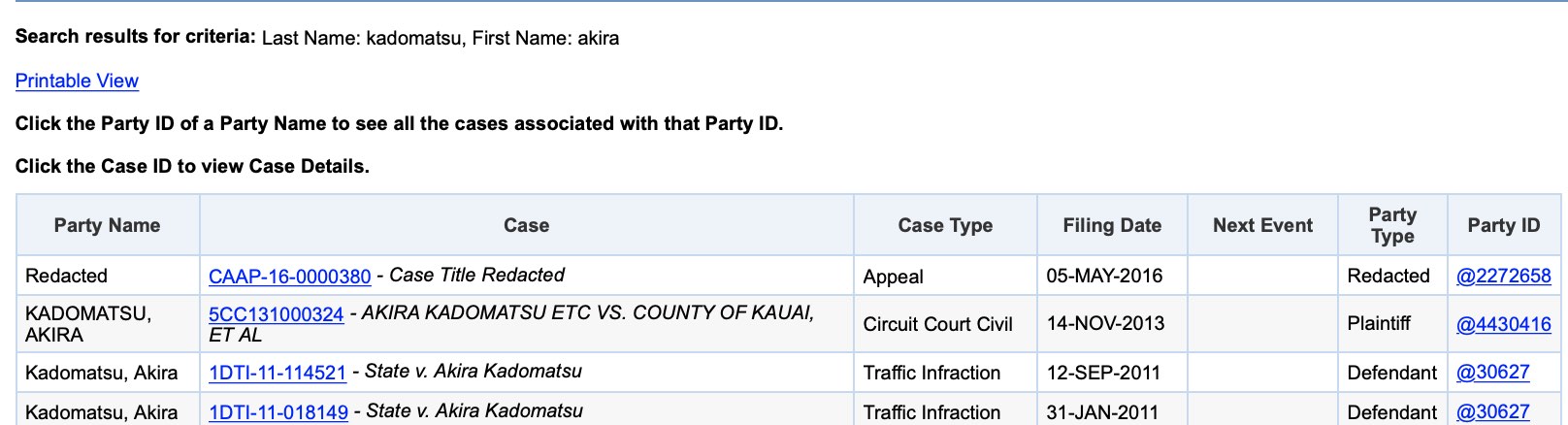
And there’s where I hit an unexpected roadblock. I searched for all cases associated with the plaintiff/victim’s name, and at the top of the list was this case with the same case number as on the Intermediate Court decision, but the case title is redacted and its files said to be confidential and not publicly unavailable.

Even though the lead plaintiff’s name is redacted, the case appears among the results returned when I used his name as the search term.

It’s common to run into lawsuits where certain documents, such as medical records, are considered confidential and are not available to the public. But having an entire case removed from the public record is quite unusual, especially what appears to be a pretty run-of-the-mill personal injury case like this one.

So on Monday I emailed Jan Kagehiro, director of the Judiciary’s Communications & Community Relations Office, to inquire whether the “redacted” status is in error. She replied that the Intermediate Court of Appeals was going to contact the court clerk’s office for further information. As of the end of the week, I had not heard further.

So I then contacted the two plaintiffs’ attorneys who handled the case regarding the “confidential” designation.

James Krueger replied first. “I had not noticed the ‘confidential’ notation,” he wrote. “I have no idea. I have never seen that notation on any of my cases in decades.”

Cynthia Wong suggested any “confidential” notation might result from minor children being included among the plaintiffs, although she did not indicate having requested the case files be marked confidential. And minors or other dependents are routinely involved in litigation without those cases disappearing in full from the public record.

So it’s one of those little mysteries that I’ll keep picking away at. Mistaken designation? If not, who requested that the case be hidden from the public? I’ll keep you posted if and when I’m able to get the answer.