Category Archives: Sunshine

It’s time to shine some light on special interests lobbying the Ige administration during this pandemic

The news concerning Hawaii’s attempts to control the spread of Covid-19 is pretty alarming. I’m not talking about the string of days with new cases in the triple digits. I’m talking about the apparently collapse of the bureaucracies entrusted to plan and implement our collective response.

One question prompted by recent reporting on the state’s response to the pandemic is simple. If administration officials aren’t heeding their detailed plan for a controlled and staged reopening of the state’s economy, and they aren’t listening to legislators, who are they listening to?

That’s a tougher question to answer than it should be, because lobbyists are free to ply their trade by steering the policies of the governor and his administration to favor the special interests the lobbyists are paid to represent. The state has a lobbyist law that restricts some activities and requires disclosure, but when it comes to lobbying the governor and his administration, under most circumstances the law doesn’t apply.

And that’s a problem.

I’ll try to spell it out.

First, kudos to Civil Beat reporter Stewart Yerton for his recent reporting.

The headline to his story on Monday summed it up pretty well: “The State Has A Plan For When To Reopen Or Reclose. Why Aren’t We Following It?

Nearly three months ago, the Ige administration rolled out its detailed plan for reopening the economy after months of being shut down.

It included detailed conditions that would have to be met in order to justify each successive loosening of community restrictions. Meet these goals, and these sectors can be given more freedom. Then work on the next level of health goals, and we were told we would then, and only then, continue to open up until we got back to a new normal.

What Yerton points out is that the whole scheme has apparently been tossed out the nearest window of the governor’s 5th floor offices, and we’re back to catch-as-catch-can decision-making without reliance on measurable criteria and public metrics to justify changes in policy.

So if they’re not paying attention to the plan, who is the administration listening to? What special interests are cozying up to the governor, his chief of staff, his chosen “economic recovery navigator”, Alan Oshima, and others at the center of administration decision-making?

We don’t know, because current law doesn’t require disclosure of these contacts. I thing that’s a key reason that Civil Beat couldn’t really answer the question about why the detailed plan for the staged safe reopening of the economy has been largely ignored. Those guiding the state’s policy are apparently unable or unwilling to explain the basis for their decisions. And lobbyists aren’t required to make their own disclosure.

The problem is that the state’s lobbyist Law turns a blind eye to lobbying executive branch officials and employees, from the governor on down.

Instead, it’s back to the unregulated Wild West when it comes to lobbyists who are paid to pressure, prod, or cajole the governor and his key staff, health officials, or department administrators involved in decision making.

If lobbyists go the capitol to persuade legislators, they are covered by the lobbyist law. But if they continue up to the 5th floor of the capitol building, where the offices of the governor and lieutenant governor are located, they’re exempt.

Why? Because Hawaii’s lobbyist law unfortunately does not apply to most executive branch lobbying. The law only applies to the executive branch when it is considering the adoption, amendment, or repeal of rules governed by the formal process of Hawaii’s Administrative Procedures Act.

So if you’re not lobbying for or against a rule being processed pursuant to the Administrative Procedures Act, the lobbyist law doesn’t apply.

If lobbbyists are trying to influence the course of the state’s pandemic response to benefit their clients, it doesn’t apply, and lobbyists are free to do their thing behind the closed doors of the governor’s office or state departments without registering or ever being called on to disclose what they are spending, or who is paying the bills.

There’s a big picture here. Lobbying is considered to be constitutionally protected activity because it is a form of petitioning the government for the “redress of grievances,” which is directly protected by the First Amendment.

But although we can’t ban lobbying, we can require disclosure so that the weight of public opinion can intervene when lobbyists’ actions appear to work against the public interest. That disclosure is a large part of what our state lobbyist law requires.

There have been several past attempts to amend the state lobbyist law so that it applies to all lobbyist of the executive branch. So far, these have not been successful.

But perhaps the experience during this pandemic will underscore for legislators the reasons the law needs to be amended, and provide some motivation to bring let a bit of sunshine follow lobbyists when they walk into those offices on the capitol’s fifth floor.

See:

The Silence from the Fifth Floor: Is This the Transparency We Were Promised?” Ililani Media, February 4, 2015

Ian Lind: Lawsuit Exposes Blind Spot in Hawaii Lobbyist Law,” Civil Beat, September 9, 2015.

“Regulating executive branch lobbying”, iLind.net, February 25, 2016.

Ian Lind: Lawsuit Exposes Blind Spot in Hawaii Lobbyist Law, Civil Beat, September 9, 2015.

Another bit of online frustration with a state data service

I’ve been doing some research that includes tracing the history of a few condominium projects.

The Real Estate Branch of the Department of Commerce and Consumer Affairs is the repository for Public Reports condo developers are required to file. These reports document the original development and marketing of condo projects and provide information potential buyers are legally entitled to.

At the top of the Real Estate Branch website is a prominent notice advising consumers that only limited staff resources are available, during limited hours, to assist the public during the Covid-19 pandemic.

Instead, “customers are strongly recommended to utilize electronic communications methods….”

Fair enough. But when your agency directs people to online services, it’s important to be sure they are up and running.

That wasn’t the case with the records I was trying to access.

The Real Estate Branch provides a link to “Resources for Condominium owners, prospective buyers, Boards of Directors, and associations.”

Clicking that link gets you a bit closer, it would appear.

Down mid-page is a further link to “CONDOMINIUM ASSOCIATION CONTACT INFORMATION, DEVELOPER’S PUBLIC REPORT DATABASE, & STATEWIDE INTERACTIVE MAP OF PROJECTS.”

Bingo. Almost there?

Click on that link and you get a disclaimer and statement of terms of use. If you want to proceed to the reports, you click “I Agree.”

Alright. I do it.

And…nothing. Nada. The request times out.

Dcca server

And it isn’t that the server is simply busy, as it has been a persistent issue over several days.

This morning I sent off email inquiries to DCCA and to a service I use that provides its own links to the state data.

I’m going to be interested if DCCA can restore public access in a timely manner.

Update: This reply from Jason Horiuchi at DCCA said the problem arose because of steps taken to protect the department’s computer systems from Hurricane Douglas. In an early morning email, he wrote:

“I actually just inquired with our IT folks about this yesterday.  They informed me that to protect it from potential damage arising from Hurricane Douglas, DCCA’s servers were shut down over the weekend.  Unfortunately they experienced difficulty bringing that particular server hosting that website back online.  Not sure on the technical details, but I was told they are “rebuilding it.” They did not have a current ETA for me, however, since they were aware of the problem and working on it I hope it is back online soon.”

Financial disclosures by mayoral candidates Pine, Blangiardi, Hannemann

City Council Member Kymberly Pine filed her annual financial disclosure statement on January 28, 2020. The City Clerk’s website does not show a later disclosure after she became a candidate for mayor.

Kymberly Pine
Spouse: Brian Ryglowski

Income

City Councilmember salary
$50,000-$99,999

Consultant/Sales
$1,000-$9,999

U.S. Navy (Spouse)
Lt. Commander
$50,000-$99,999

Creditors

KIA Finance Co.
Outstanding: $1,000-$9,999

Cooper (Joint)
$700,000-$799,999

Ownership or interests in businesses

RTY Imports
Importing goods/sales
100% owned by Pine
Value: Less than $1,000

Fiduciary Positions
US Vets (Kapolei)
Honorary Board Member (2005-present)
Compensation: None

Real Property Owned

Personal residence (Joint)
Year obtained: 2015
Value: $900,000-$999,999
[*Note: Real estate records show Pine and her husband purchased an Ewa Beach home in February 2014 for $844,000 via a 39-year Veteran’s Administration loan.]

Richard J. “Rick” Blangiardi filed his financial disclosure on June 8, 2020.
Spouse: Karen Chang

Income

Gray Media Group, Inc.
General Manager
Income: At least $1 million
*No income reported for his spouse

Creditors

AMEX
Outstanding: $10,000

Ownership or interests in businesses

None.

Fiduciary Positions

YMCA of Honolulu
Board member
January 2020 – December 2023
Compensation: None

Real property owned

Admiral Thomas Apartments (Condominium)
Penthouse
Value: $4 million
Year obtained: 2014
[*Note: Real estate records show Blangiardi and Chang purchased the 4,380 square foot penthouse apartment in October 2014 for $1.6 million. It is current appraised for tax purposes at $1,960,400.]

Former mayor Muliufi F. “Mufi” Hannemann filed his candidate financial disclosure on June 22, 2020.
Spouse: Gail Akiko Mukaihata Hannemann

Income

Hawaii Lodging and Tourism Association
President & CEO

2011 to present
Annual Income: $200,000 – $299,000

MFH Enterprises
Consultant
2011 to present
Annual Income: $100,000-$150,000

Creditors

First Hawaiian Bank (Joint)
Amount Outstanding: At least $1 million

Bank of Hawaii (Joint)
Amount Outstanding: $25,000-$49,999

First Hawaiian Bank (Joint)
Amount Outstanding: $100,000-$149,999

Ownership or interests in businesses

Wailuku Water Company LLC (Mufi)
Percentage of interet: 0.218055%
Value: $10,000-$24,999

MFH Enterprises
Consulting
100% owned
Value: $300,000-$399,999

Fiduciary Positions

Fund of the Pacific Century
Board Chairman
Compensation: None

University of Hawaii Travel Industry Management School
Advisory Board member
Compensation: None.

American Diabetes Association
Advisory Board member
Compensation: None

The Hawaii Arts Alliance (Spouse)
Member, Board of Directors
Compensation: None

Asian & Pacific Islander American Health Forum (Spouse)
(Oakland, CA)
Member, Board of Directors
Compensatio: None

Hawaii Management Alliance Association
Member, Board of Directors
Compensation: $50,000-$99,999

Real Property Owned

Personal residence (Joint)
Year obtained: 2017
Value: At least $1 million
[*Note: Real estate records show the Hannemann’s purchased the home high on Waialae Iki ridge in September 2017 for $1,555,000, with a $1,088,500 mortgage loan from First Hawaiian Bank.]

99-437 Ulune Street, Aiea (Joint)
Year obtained: 1992
Value: $800,000-$899,000
[*Note: Real estate records show the Hannemann’s took a homeowners exemption for this home until 2017, when they purchased the Waialae Iki house, where they now live.]

See the forms as filed.

Kym Pine

Rick Blangiardi

Mufi Hannemann

What do public records disclose about me?

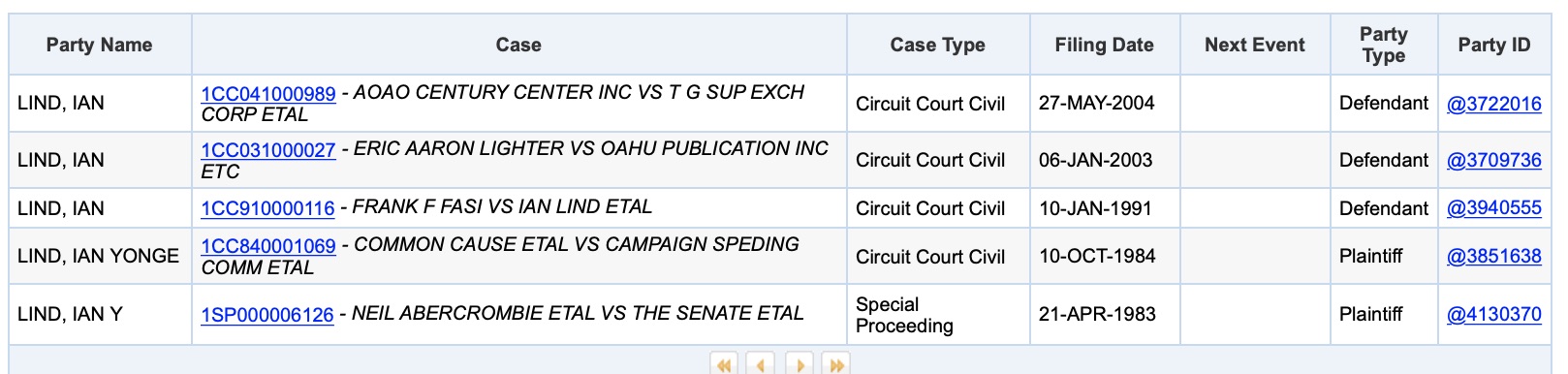
While looking through the disclosures filed by Honolulu’s mayoral candidates, I wondered what would turn up if someone dug around in court records looking for my name.

So I logged on to the state and federal court computer systems, and entered my name in the search field.

I’m very proud of the series of legal cases that were returned.

The search in Hawaii court records didn’t turn up any traffic violations or legal issues, just a short list of civil lawsuits.

I’ll start with the oldest case, Neil Abercrombie v. The Senate, filed in April 1983. That was my first legislative session as director of Common Cause Hawaii, and I was a co-plaintiff with dissident state senators who filed suit over the right to inspect the budget worksheets. The lead named plaintiff was Neil Abercrobie, who later served ten terms in the U.S. House of Representatives before being elected governor. Although the lawsuit was declared moot, it led to internal changes in the Senate which resulted in far more public access to the budget documents.

The following year, I was a co-plaintiff with Common Cause in a suit against the Campaign Spending Commission over an interpretation of the campaign laws that would have gutted public disclosure of campaign contributions. After the lawsuit was filed, the commission reversed course and adopted the position Common Cause had advocated.

Then in 1991 I was sued by then-Honolulu Mayor Frank Fasi for suggesting during a television news interview that patterns of large contributions from special interest groups, such as those to Fasi’s campaign, created the appearance of corruption. Fasi soon dropped the case, reportedly under pressure from others in his party.

In 2003, I was sued by Eric Aaron Lighter, and accused con-man who alleged he was defamed by a story published while I was writing for the Honolulu Star-Bulletin. As I recall, the lawsuit was never actually served and was later dismissed. In December 2011, following a two-week trial, a federal jury in Northern California took just one day to find Lighter guilty of all 17 charges he faced, including multiple counts of conspiracy, wire fraud, witness tampering, and blackmail.

At the time the next case was filed in 2004, I was president of the Century Center Condominium board of directors. The condo association sued an apartment owner over a series of violations of the building’s declaration and bylaws which had created continuing problems. During that same time period, the owner, an attorney and former state judge, opened a nightclub in a penthouse apartment in violation of usage rules, but I don’t recall if that had been the trigger for this suit. Court records show the court approved the injunction sought by the AOAO and awarded $18,455.39 in attorney fees.

Then, over in federal court, this appears in the index of the Pacer online system.

This 1992 case challenged the constitutionality of a broad confidentiality requirement that applied to complaints filed with the state Campaign Spending Commission. At the time, I was publishing a monthly newsletter about money and politics in Hawaii, and a dispute had arisen over my right to publish information about a complaint I had filed with the commission. The case, Lind v. Grimmertx, resulted in the confidentiality provision being declared unconstitutional, a decision that was upheld by the Ninth Circuit Court of Appeals. The state filed an appeal with the Supreme Court, which declined to consider it. The case had been widely cited in later 1st Amendment decisions.

I was also the lead plaintiff, along with the American Friends Service Committee, in a 1980 Freedom of Information lawsuit seeking public disclosure of several specific documents concerning prior U.S. Navy accidents involving nuclear weapons. The case dragged on for years, finally resulting in the release of 125 pages of records, including summaries that included the number of accidents, general types of accidents, and their causes. The court ruled we had substantially prevailed and order the Navy to pay $15,682.50 in attorney fees and costs.

Whew. I hadn’t thought about those legal cases in a long time. Quite an interesting slice of history.