Category Archives: Sunshine

My set of quick research bookmarks

One of the topics that came up during the Civil Beat panel discussion of corruption is how we do our work as investigative reporters. By “work”, I’m not necessarily speaking of paid employment. Work is something done seriously, with focus, whether for pay or as an uncompensated activity. A “hobby,” if you will. I’m mostly retired in the paid-employment sense, but still work hard in that other sense of using my experience and skills to work on issues of import.

Along those lines, I decided to share the bookmarks I’ve collected to search for public records I use daily when digging into a story or just working around the fringes trying to get a better sense of whether there is a story.

I have these set up in a separate bookmark folder in my browser for quick access. It’s not an exhaustive list of resources. It’s a starter kit of useful links, you could say.

If you’ve got other suggestions, please share them.

They aren’t in any particular order, just where they landed as I gathered them in one place.

I’ll just walk through the list from the top.

• Judiciary opinions. This goes to a list of appellate decisions in Hawaii state courts. It is often a source of detailed information about people and situations that is unavailable elsewhere.

• Hawaii Business Express. This is the business search via the Business Registration Division of the Department of Commerce and Consumer Affairs. If you’re looking for info on a business, this is one place to start. You can learn when a business was first registered, its current status, past business filings (name changes, trademarks, change of officers, etc). Searching and basic information is free, and you can also download documents for a fee of $1 per page.

• eCourt Documents. This is a link to the Judiciary Electronic Filing and Service System. It’s used to access dockets of most state court cases and to download copies of documents, again for a fee. I have a subscription which allows unlimited downloads, and make heavy use of it when digging into a story.

• Hawaii Information Service. This is subscription service which maintains a computer database of public records. Although primarily used by realtors for tracking real property records, it also includes value-added searches of state business registration and professional/vocational licensing. You can do searches here that can’t be done on the free public systems. Expensive, but worth every cent. I don’t remember when I first subscribed. It was a real splurge, but I’ve never once regretted it. A goldmine for reporters, investigators, lawyers, as well as realtors.

• Hawaii Legal Research. A useful compilation of links used in legal research, current and historical. When I’m kind of stuck, I’ll browse these links for ideas of how to proceed.

• Conveyances. This links to the basic search at the Bureau of Conveyances. If you are researching a person or business, you can check for mortgages and other secured loans, liens, trace real property ownership and transfers, judgements, etc. Again, copies of documents are available for a fee. Under normal non-Covid circumstances, you can go to the bureau and inspect documents without any fee.

• iLind.net Log-in. A quick link when I’m updating something on my own WordPress blog.

• Professional and Vocational Licensing. This is a free search through individuals and businesses with licenses issued by the state. Everything from contractors and electricians to vehicle salespersons and massage therapists. You’ll have to look up the list of license categories.

• Complaints. Search consumer complaints against licensed individuals and businesses filed with the state’s Regulated Industries Complaints Office.

• Honolulu Advertiser–Search the for stories appearing in the former Advertiser before its merger with the Honolulu Star-Bulletin in 2010. This search is via Newspapers.com.

• Pacific Business News. I subscribe to PBN for their current business news, but also for their excellent searchable archive of past stories.

• Campaign Spending Commission. Go to the source for information on candidates and noncandidate committees (businesses, unions, and political action committees), campaign contributions, etc.

• RECAP. An add-on utility (I use it with Firefox) for searching the PACER system of federal court records. When a RECAP user pays to download a file, a copy is automatically uploaded to RECAP and is then available for free for subsequent users. It often can save you real money when researching a case.

• HPD Arrest Logs. I just recently added this link. It’s raw data, but I’ve made good use of it so far.

• Newspapers.com. Worth every penny of the annual subscription fee.
Judge’s order favors disclosure of documents in Miske-related case

Federal Judge Leslie Kobayashi issued an order on Thursday directing the court clerk to publicly disclose previously confidential documents filed regarding the search warrant and seizure of the boat prosecutors say was used to dump the body of Jonathan Fraser into the ocean after he was kidnapped and murdered. Prosecutors allege the killing was part of a murder-for-hire plot directed by Honolulu businessman Michael J. Miske Jr.

The documents will be made public on November 23, 2020, unless one or more defendants in the Miske case can “demonstrate the disclosure will cause irreparable harm to one or more of the defendants’ fair trial rights or some other compelling interest…” or unless otherwise directed by a future order of the court.

Kobayashi ruled prosecutors failed to provide specific facts sufficient to outweigh the public interest in disclosure of the documents, which were sealed when originally filed in court.

“The Government has not made a compelling showing to overcome Petitioner’s qualified right of access under the First Amendment,” Kobayashi wrote.

They must show that non-disclosure “is strictly and inescapably necessary” in order to protect the Defendant’s fair trial guarantee or some other compelling interest. This is a high bar, surmountable only by establishing a substantial probability that: (1) disclosure will cause irreparable harm to the Defendant’s fair trial rights or some other compelling interest; (2) there is no alternative to continued secrecy that will adequately protect the right or interest; and (3) non-disclosure will effectively protect against the perceived harm.

Kobayashi’s ruling came in response to a lawsuit filed by the Civil Beat Law Center for the Public Interest challenging the continuing secrecy regarding the search warrants now that Miske and ten associates have been indicted on charges that include Fraser’s kidnapping and murder.

Kobayashi’s order and other documents in the Civil Beat Law Center’s case can be found on its website.

State Auditor slams lack of transparency of DOH admin

The auditor just dropped their report on the contract tracing efforts of the State Department of Health.

I haven’t had a chance to read through it yet, but the auditor’s comments that preface the report are devastating.

Auditor’s Comment

Transparency and Accountability – Now More Than Ever

We recognize that the Department of Health had myriad responsibilities when it did not respond to our request for information on its contact tracing efforts; however, it is precisely during times of crisis when the public needs and deserves clear, concise, and transparent communication from its government.

As Hawai‘i has watched its total number of COVID-19 cases more than double since the end of July, a growing sense of urgency has intensified scrutiny of the Department of Health’s (DOH) contact tracing program. Leadership of the department’s contact tracing efforts has been heavily criticized by the public and government officials, including the Lieutenant Governor and a member of the Hawai‘i Congressional delegation.

We intended to report on DOH’s contact tracing process, primarily to filter through the varying, confusing, and often conflicting information and to provide a clearer, objective, and up-to-date understanding of the department’s efforts. However, instead of cooperation and assistance, we encountered barriers, delays, and ultimately were denied access to those responsible for leading the department’s contact tracing: the Disease Outbreak Control Division (DOCD) Chief and the Disease Investigation Branch (DIB) Chief, who recently took over that task. While the Health Director spoke with us, failing to respond to numerous requests until a few hours before the interview, he repeatedly directed us to speak with the DOCD Chief for answers to specific questions about the department’s contact tracing process. At the end of our discussion, the Director said he would ask the DOCD Chief to talk to us and would provide us with documents we had requested in multiple letters to him, including the department’s policies and procedures relating to contact tracing. However, the DOCD Chief did not contact us, and the Health Director did not provide the requested documents.

The Deputy Director for Health Resources provided us with a time when the DIB Chief was available to speak with us. In her email, the Deputy Director instructed us to include the Attorney General on future communication and that the Attorney General would participate in our meeting with the DIB Chief. However, on the day of our scheduled meeting, the DIB Chief informed us that the Deputy Director, her boss, was mistaken about her availability and said she was too busy to speak with us. The Governor’s Chief of Staff subsequently contacted us to repeat that the DIB Chief was unavailable.

While we understand DOH staff are busy, especially those working to improve the department’s contact tracing approach, we expected the department’s full and timely cooperation. We did not expect the Attorney General or the Governor’s office to involve themselves in our attempt to report about DOH’s approach to contact tracing. We are not a political office. We are an office established by the State Constitution to provide objective, unbiased assessments of government operations. We can only do our job with unimpeded and complete access to an agency’s program.

Now, more than ever, DOH must be transparent and accountable. The lack of cooperation we received is, frankly, inexcusable. Public confidence in the department, specifically in its ability to perform timely contact tracing of the growing number of positive cases, has been eroded. The community now has many questions about the process that DOH has, for months, represented as under control. For DOH to effectively protect public health and reduce the spread of the novel coronavirus so we can begin re-starting our economy, it is critical the department rebuild public trust. This health emergency demands DOH ensure that its response is transparent by providing the public with complete, timely, and accurate information.

We hope the department will fully and promptly cooperate with future requests.

Leslie H. Kondo State Auditor

Where is the state’s Board of Health when we really, really need it?

Last year the legislature, in its infinite wisdom, decided to do away with the Board of Health, which had been around for more than a century.

HB898 SD1 (2019) abolished the Board of Health, which had been established to advise the health director on any matters within the department’s jurisdiction.

The bill was introduced by Rep. Della Au Belatti, House Majority Leader, and Health Committee Chair John Mizuno. An identical measure was introduced in the Senate by Stanley Chang (“by request”).

The only testimony on the measure over the course of public hearings before three different committees was a one-page sheet of written testimony submitted on behalf of the Department of Health. The testimony does not indicate whether it was delivered in person, and two of the three committees stamped it “Late,” meaning it was received after the hearing deadline.

No testimony was received from any health providers, health care or community organizations, public health experts, or concerned individuals.

Here’s how the legislators justified the move.

The legislature finds that the board of health was originally intended to serve as an advisory panel to the director of health. However, given the current breadth and complexity of public health issues and prominent guidance from federal programs, the legislature, and the private sector, the board of health has been rendered obsolete and no longer adds value to department of health operations.

The legislature further finds that the board of health has been historically difficult to fill and currently has no members. Abolishing the board of health would more accurately reflect the reality of decision making at the department of health and would reduce the administrative burden on the department.

One thing apparently forgotten along the way. A public board at the top of a department may become the primary access point for concerned members of the community, and a critical avenue for holding a complex agency accountable to the public.

That was the point made by two people who testified on the Senate version of the bill.

“Eliminating the Board of Health will lead to less transparency of the Department of Health and less accountability,” one person noted in opposing the bill.

A second person wrote:

“To have the department of health decisions made by one or two people is leaving grande decision making in a vacume of thought. The department of health needs a sounding board and a committee to keep as a voice of reason and understanding of complex issues.”

In hindsight, their concerns appear spot-on. When the current pandemic brought us face-to-face with a real public health crisis, it’s been the lack of transparency and accountability that have finally become the real story behind the department’s chronic ineptness.

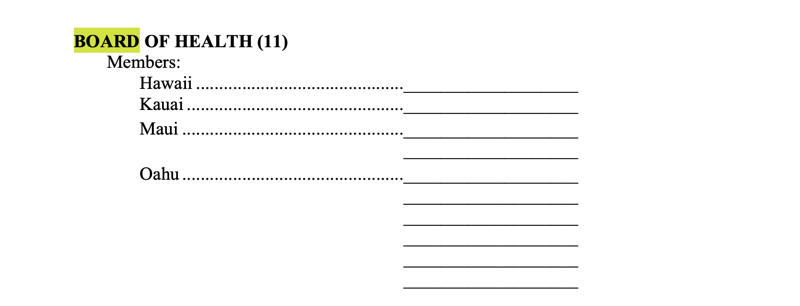
Even before passage of HB898 SD1 eliminated the Board of Health, it had been gradually starved and allowed to wither away. Vacancies on the board were not filled, until eventually it became a ghost board on the top of the Health Department’s organizational chart.

This was the list of members that appeared in recent editions of the standard publication produced by the Legislative Reference Bureau, “Guide to Government in Hawaii.”

Board of health members none